Financial Advice for Professional Sportspeople: Planning Beyond Your Sporting Career

Key takeaways
Plan around income after tax and costs, rather than headline contract values.
Keep accessible resources for uncertainty and the transition out of sport.
Retiring from sport does not automatically unlock your pension.
Investment risk, protection and overseas tax need to fit the wider plan.
Review the plan when contracts, health, family needs or country of residence change.

A successful sporting career can change your financial life quickly. A first professional contract, a breakthrough season or a sponsorship deal may create opportunities that would otherwise take years to build. The challenge is making those opportunities support a life that lasts far longer than the contract.
Financial advice for professional sportspeople needs to reflect that different timetable. Earnings may vary, performance and health can affect your options, and the move into a second career can arrive well before conventional retirement age. For some athletes, the first priority is covering the costs of competing. For others, it is turning substantial but temporary income into lasting financial security.
Your financial plan should make room for the career you hope to have, while remaining workable if it takes a different direction.
Why a sporting career needs a different financial timetable
Footballers and rugby players may depend on fixed-term contracts. Golfers, tennis players and other touring athletes may face unpredictable prize money alongside travel, coaching and support costs. Sponsorship can supplement earnings, but its duration and conditions matter just as much as its headline value.
The result is a planning question that is easy to overlook during a strong season: how much of today’s income can safely become tomorrow’s spending commitment?
A mortgage, family support or a property purchase can continue long after a contract ends. A sensible plan distinguishes between recurring commitments, discretionary spending and money being set aside for the future. It should also recognise that a second career may provide meaningful income; that income needs realistic assumptions rather than being ignored or taken for granted.
Start with what you actually keep
A gross salary, signing-on payment or sponsorship agreement is not a measure of investable wealth. Tax, agent fees, professional costs, borrowing and family commitments all affect the amount available. The treatment of each payment and expense should be confirmed with your accountant.
I would begin by bringing your income, assets and obligations together. That includes payment dates, the certainty of future receipts, existing investments and pensions, and the spending that matters to you. Clear reporting can be particularly helpful when several people advise on different parts of your affairs.
Reserving money for tax before committing it elsewhere can prevent a good earnings year from creating a later cash shortage. The size of an emergency reserve should reflect the stability of your contract, support available, dependants and the costs of maintaining your career.
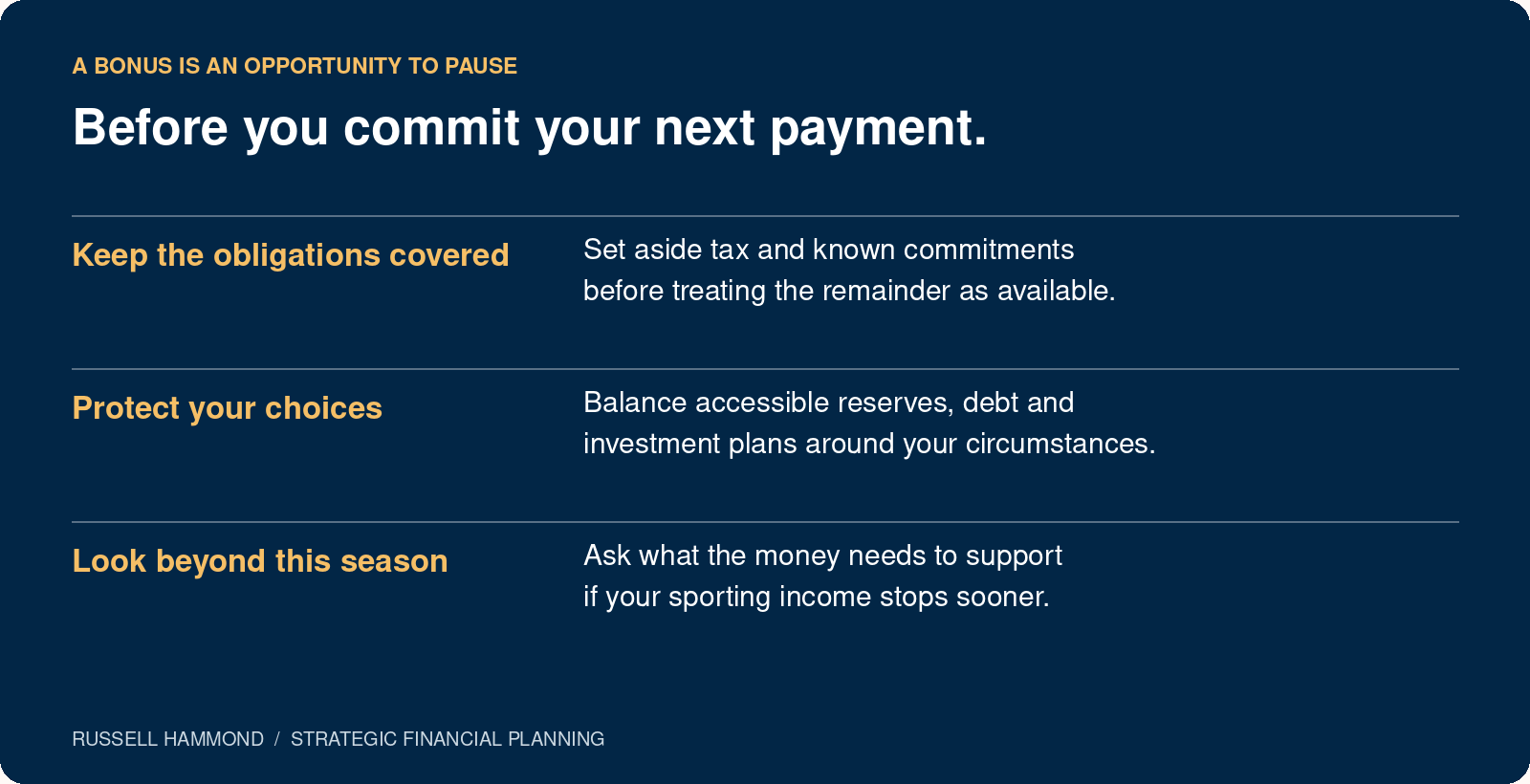
Before you commit your next payment
Keep obligations coveredSet aside tax and known commitments before treating the remainder as available.
Protect your choicesBalance accessible reserves, debt and investment plans around your circumstances.
Look beyond this seasonAsk what the money needs to support if sporting income stops sooner.
Separate the end of sport from the start of pension income
Retiring from professional sport and retiring financially are different events. Leaving competition in your thirties or forties can create a lengthy period before pension benefits are available. That period may be funded through a combination of accessible savings, investments, employment or business income.
Most UK pensions cannot simply be drawn because your sporting career has finished. The normal minimum pension age is scheduled to rise from 55 to 57 on 6 April 2028, subject to exceptions and scheme rules. Some older arrangements have a protected pension age, but you should never assume that a special early-access right applies just because you are an athlete. A transfer can affect protection.
See HMRC’s pension-age guidance and protected pension ages for certain older personal pensions.
This is why I would look at the timing of access alongside tax efficiency. Money that is well placed for later retirement may still be unavailable when you need to fund retraining, a career break or the first years after sport.
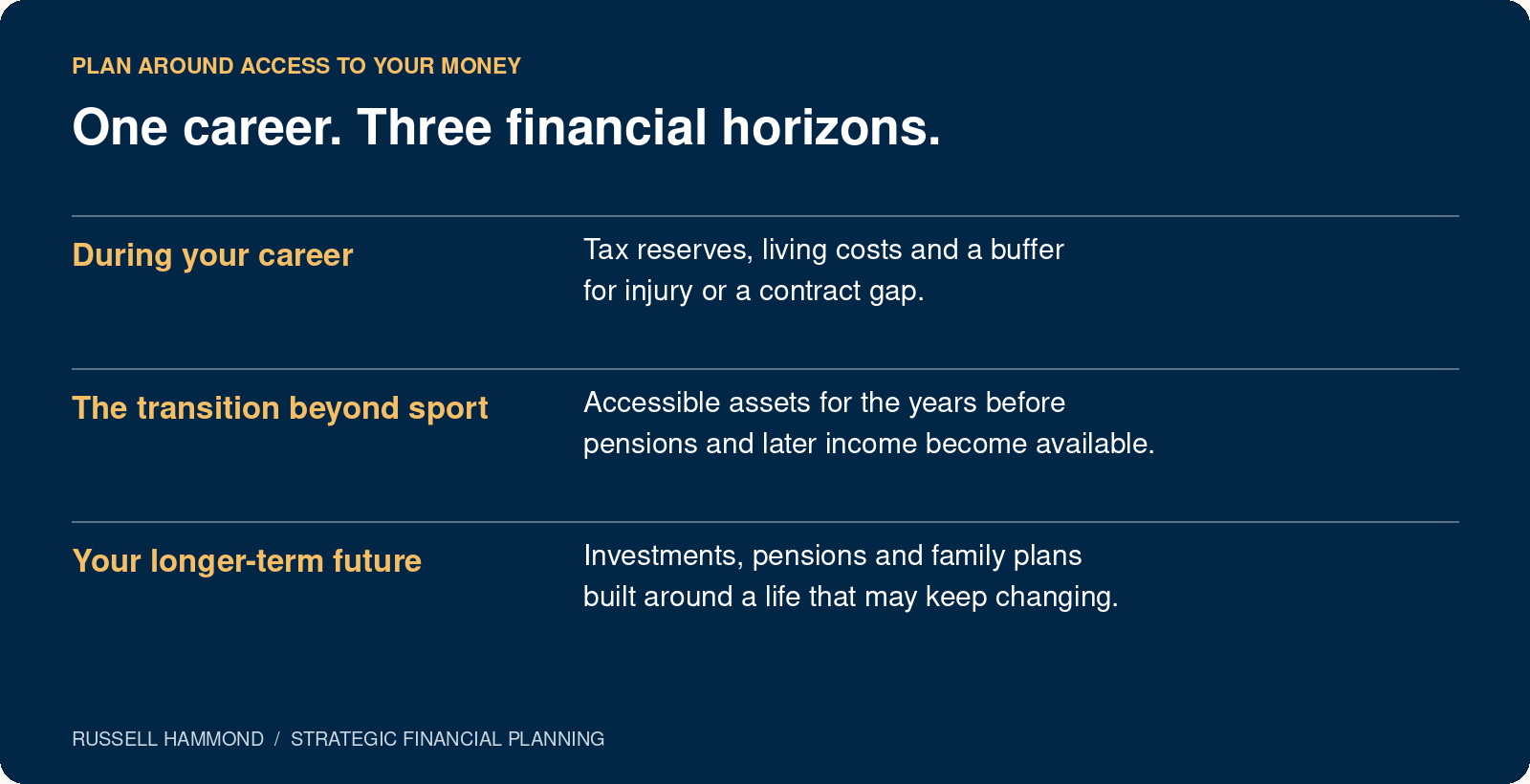
One career. Three financial horizons.
During your careerTax reserves, living costs and a buffer for injury or a contract gap.
The transition beyond sportAccessible assets for the years before pensions and later income become available.
Your longer-term futureInvestments, pensions and family plans built around a life that may keep changing.
Explore the years between sport and pension access
The simple illustration below shows how an annual spending gap adds up across that period. It is a starting point for discussion, not a retirement forecast or a recommended amount to save.
Your transition from sport
Use today’s spending and income in pounds per year. Enter your own confirmed pension-access age.
Simple arithmetic only: the annual gap multiplied by the years to the assumed access age. Figures are in today’s money. No investment growth, inflation, tax changes, fees, irregular costs or changes in income are modelled. This is not a recommended savings target, pension eligibility check or test of affordability. Nothing is submitted or saved.
Proper cashflow and lifestyle planning can explore much more: different career lengths, inflation, investment falls, family spending and the timing of future income. It should be revisited as the facts change.
Invest for your future without depending on one outcome
Investment planning should begin with the purpose of the money. Resources required for a near-term tax bill or a possible contract gap have a different job from capital intended for later life. A high income does not automatically create a high capacity to absorb investment losses.
Property, a private business or an opportunity introduced by someone you know may feel more tangible than a portfolio. Each still needs scrutiny. Borrowing, ongoing costs, difficulty selling and concentration in a single asset can make an apparently attractive investment unsuitable for money you may need quickly.
I would consider diversification, access, costs and the level of risk your wider plan can tolerate. An evidence-based approach does not remove investment risk or guarantee a result, but it can provide a disciplined framework for decisions. You can read more about my approach to investment management.
Be particularly cautious when an investment is presented as exclusive, guaranteed or available only if you decide immediately. Understand who is providing it, how they are paid, what you own and how you could get your money back.
Use pensions thoughtfully, with the limits checked
Pensions can play a valuable role in later-life planning, but a large earnings year does not mean unlimited tax-relieved contributions are available. The annual allowance covers relevant pension saving across schemes, including employer contributions, and may be reduced for high earners.
Unused annual allowance from earlier years may sometimes be carried forward, subject to the conditions. Personal contributions also have separate tax-relief requirements linked to relevant earnings. Contribution planning should therefore be checked against your actual income, existing scheme benefits and any protection before a payment is made.
HMRC explains the annual allowance, the high-income taper and the limits on contribution tax relief. The right balance between pensions and accessible assets depends on your timetable.
Check what happens if you cannot compete
Before arranging extra cover, establish what your club, employer, governing body or existing policies already provide. Understand how long salary or other support continues, the definition of incapacity and whether protection follows you between contracts or countries.
Insurance needs can include support for dependants and cover relevant to illness or injury. Availability, exclusions and underwriting vary, particularly for professional sporting activities. Career-ending cover, where available, should not be assumed to replace every future source of income.
I would consider the financial consequences alongside any appropriate specialist insurance advice: what must still be paid, what can change and how much flexibility your accessible resources provide. Your Will and decision-making documents also deserve attention as family circumstances develop.
Coordinate tax advice when your career crosses borders
An overseas contract is a financial planning event as well as a career decision. Before moving, consider tax residence, where different payments arise, currencies, pension arrangements and the rules that apply where you will live and compete.
Living outside the UK does not automatically remove UK tax obligations. Non-resident sportspeople may still be taxed on UK performances and an attributable share of worldwide sponsorship or endorsement income. The contract wording and sporting or training activity can affect the calculation.
HMRC sets out the position in its guidance on UK tax for overseas sportspeople. Broader residence rules also matter. Advice from an accountant experienced in sporting income, together with local advice where needed, should be coordinated before decisions are committed.
My role in cross-border planning is to connect those considerations with your wider financial objectives, within the scope of the advice I can provide. An offshore account or product does not make income exempt from tax.
Different careers. Different planning conversations.
These hypothetical examples illustrate planning questions. They are not client cases, outcomes or personal recommendations.
A first substantial contract
A young team player wants to buy a home and help their parents after signing a better-paid contract. I would explore the net income, the contract’s duration, borrowing commitments and a plan for saving before higher spending becomes permanent. Helping family should be considered alongside the player’s own security.
A touring athlete with uneven income
A tennis player earns prize money and sponsorship but also pays significant coaching and travel costs. I would explore cash reserves, payment timing, currency exposure and how the plan changes if tournament results or sponsorship receipts fall short. Tax coordination would form part of that wider conversation.
A final contract and a new direction
An established professional wants to stop competing at 36 and retrain. I would map spending, accessible assets and potential second-career earnings against the years before pension access. I would also test an earlier finish and a slower transition into paid work, rather than making the plan depend on the most optimistic scenario.
Bring the people advising you around one plan
Your agent, accountant, solicitor and financial planner can each have a different role. Clarity about responsibilities, fees and conflicts of interest helps you understand whose advice you are receiving and what it covers. Commercial contract negotiations and specialist tax or legal questions should sit with appropriately qualified professionals.
As a Chartered Financial Planner and Chartered Investment Adviser with more than 20 years’ experience, I can help you connect the moving parts through Strategic Financial Planning. The starting point is your circumstances and ambitions, followed by a clear scope of work and agreed fees.
The aim is to give the money you earn through sport a purpose beyond the next season—and keep your future choices in view.
If you are signing a new contract, considering an overseas move or preparing for the transition out of sport, I would be delighted to discuss what you want to plan for.
General information only, not personal financial, tax, legal or insurance advice. Tax treatment and eligibility depend on individual circumstances and rules may change. Investments can fall in value and you may get back less than you invest. Specialist legal, tax, insurance or overseas advice may be required.
Frequently Asked Questions
Why do professional sportspeople need financial advice?
A sporting career can combine uncertain contract income, substantial costs and an early change in earnings. Financial advice can connect spending, tax reserves, protection, accessible investments and pensions around both the career and the life that follows. Not every athlete has high earnings, so the plan should begin with actual resources and commitments.
Can professional sportspeople access their pension when they retire from sport?
Finishing a sporting career does not automatically allow early pension access. Most UK pensions are subject to the normal minimum pension age, which is scheduled to rise from 55 to 57 on 6 April 2028. Some older arrangements have a protected pension age; the precise scheme rights and any effect of a transfer must be checked. Separate accessible assets may be needed before pensions can be drawn.
How much should an athlete save from a bonus or signing-on payment?
There is no universal percentage. First establish the net payment after tax, contractual costs and existing commitments. Then consider reserves, debts, future spending, pension limits and the length of the remaining career. A large gross payment is not the same as money freely available to invest.
Does moving abroad mean a sportsperson stops paying UK tax?
No. UK tax residence, the source of income, the sporting activity and any relevant treaty all matter. Non-resident sportspeople can still owe UK tax on UK performances and an attributable share of sponsorship or endorsement income. Obtain coordinated UK and local tax advice before moving or signing contracts.
Should a sportsperson invest in property or a diversified portfolio?
Neither is automatically right for every athlete. Property can bring borrowing, maintenance, concentration and liquidity risks. A diversified portfolio also carries risk and can fall in value. The choice should reflect accessible reserves, time horizon, tax, costs and how much of the wider financial plan depends on the investment.
Continue reading
How Much Can I Afford to Give My Children? Retirement Risk and Family Wealth Planning
A deeper look at family gifting, sequence risk, longevity and inheritance tax, with an interactive explorer comparing retirement resilience before and after a gift.
Beyond Investment Management: Strategic Financial Planning
Managing substantial wealth can become surprisingly complicated. You may have built a successful business, accumulated significant investments, acquired property, established pension arrangements and created financial security for your family. [...]
Financial Advice for Lottery Winners
Won the lottery? Explore a £5 million example and how I can help with investments, income and family gifts. Book a free, confidential initial conversation.