Financial Life Management: Your Personal CFO for Life’s Important Financial Decisions

Key takeaways
Financial life management goes beyond investment management to coordinate the wider financial picture.
A personal financial CFO provides strategic oversight, helping ensure pensions, investments, retirement income, tax considerations and family priorities work together.
Complex financial decisions often require coordination between financial advisers, accountants, solicitors and other specialists.
Cash-flow modelling and ongoing reviews can help assess the long-term consequences of major decisions.
The ultimate objective is to organise wealth around the life you want to lead.
Financial Life Management: Your Personal CFO for Life’s Important Financial Decisions
Managing wealth can become surprisingly complicated.
You may have built a successful business, accumulated substantial investments, acquired property, established pension arrangements and created financial security for your family.
Yet the more successful you become, the more difficult it can be to ensure that every part of your financial life is working together.
Your accountant may handle your tax returns. Your solicitor looks after legal matters. Your investment adviser manages your portfolio. Your pension provider administers your retirement benefits.
Each may be doing an excellent job.
But who is looking at the whole picture?
Who is ensuring that decisions about investments, retirement, taxation, borrowing, business interests and family wealth are coordinated, rather than considered separately?
This is where financial life management becomes valuable.
My approach is to act as something of a personal Chief Financial Officer (CFO) for my clients: a central point of financial guidance, helping them make important decisions, coordinate professional advice and structure their wealth around the life they want to lead.
It is about much more than selecting investments or reviewing portfolio performance.
It is about bringing clarity, structure and continuity to your entire financial life.
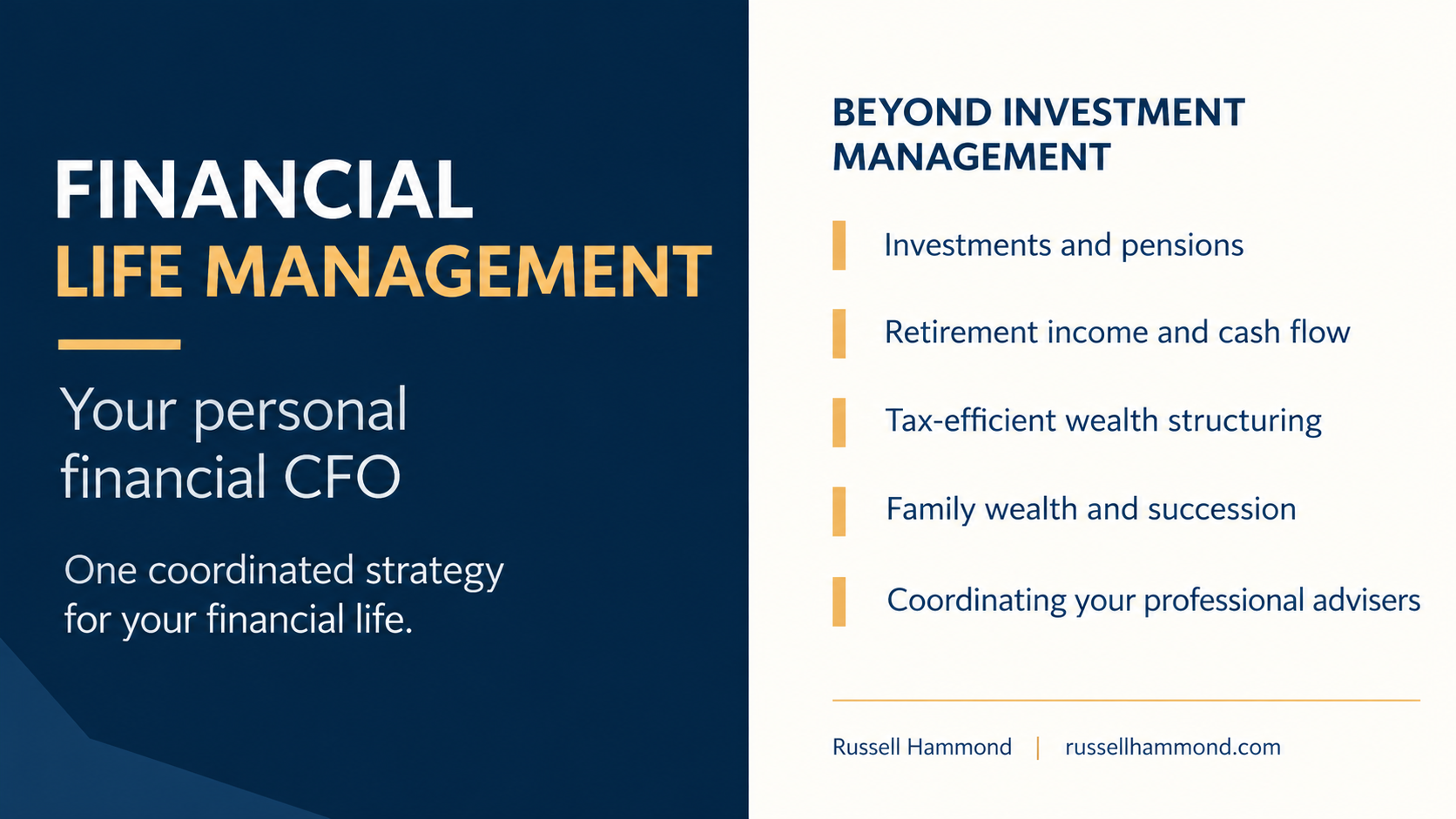
What Does a Personal Financial CFO Actually Do?
A business with significant assets, complex financial responsibilities and important long-term objectives would rarely operate without someone taking overall responsibility for its financial strategy.
That responsibility typically belongs to the Chief Financial Officer.
A good CFO does not necessarily perform every specialist task personally. Instead, they understand the organisation’s financial position, anticipate future requirements, coordinate professional input and ensure that individual decisions support the wider strategy.
I believe there is considerable value in applying a similar approach to personal wealth.
For many successful individuals and families, financial life can become every bit as complex as the finances of a small business.
There may be investments held across multiple institutions, pensions with different benefits and withdrawal rules, property, business interests, tax considerations, borrowing needs, inheritance planning and family commitments.
The challenge is not simply managing each arrangement competently.
It is ensuring that the arrangements work together.
As your financial adviser, I aim to provide that overarching perspective.
I help identify the decisions that matter, examine how they interact and coordinate the appropriate professional expertise where required.
This does not mean replacing your accountant, solicitor or other specialist advisers. Quite the opposite: an important part of the role is ensuring their expertise contributes to a coherent financial strategy.
Why Traditional Investment Management Is Not Enough
Investment management is important. In many cases, it represents a substantial part of the financial planning relationship.
But investment performance is not the same as financial success.
Consider an individual with £3 million of investable assets, several pensions, a valuable property and plans to retire within five years.
An investment manager may construct a well-diversified portfolio and deliver appropriate investment performance.
But that alone does not answer some of the most important questions:
-
How much can the individual afford to spend during retirement without placing their long-term security at unacceptable risk?
-
Which accounts and pensions should fund their expenditure, and in what sequence?
-
What tax liabilities might arise when accessing different assets?
-
Should surplus wealth be retained, gifted to family members or structured differently?
-
What happens if the individual dies unexpectedly or becomes unable to make financial decisions?
-
How should the strategy change if they relocate overseas, sell a business or receive an inheritance?
These questions cannot be answered by looking at investment returns alone.
They require a broader assessment of wealth, taxation, family circumstances, risk and long-term objectives.
I regularly use cash-flow modelling to examine how different decisions might affect a client’s financial future, including the consequences of retiring earlier, spending more, making gifts or experiencing weaker investment returns.
The purpose is not to predict the future with certainty. It is to understand the range of possible outcomes and make better-informed decisions today.
The Difference between investment management and financial life management
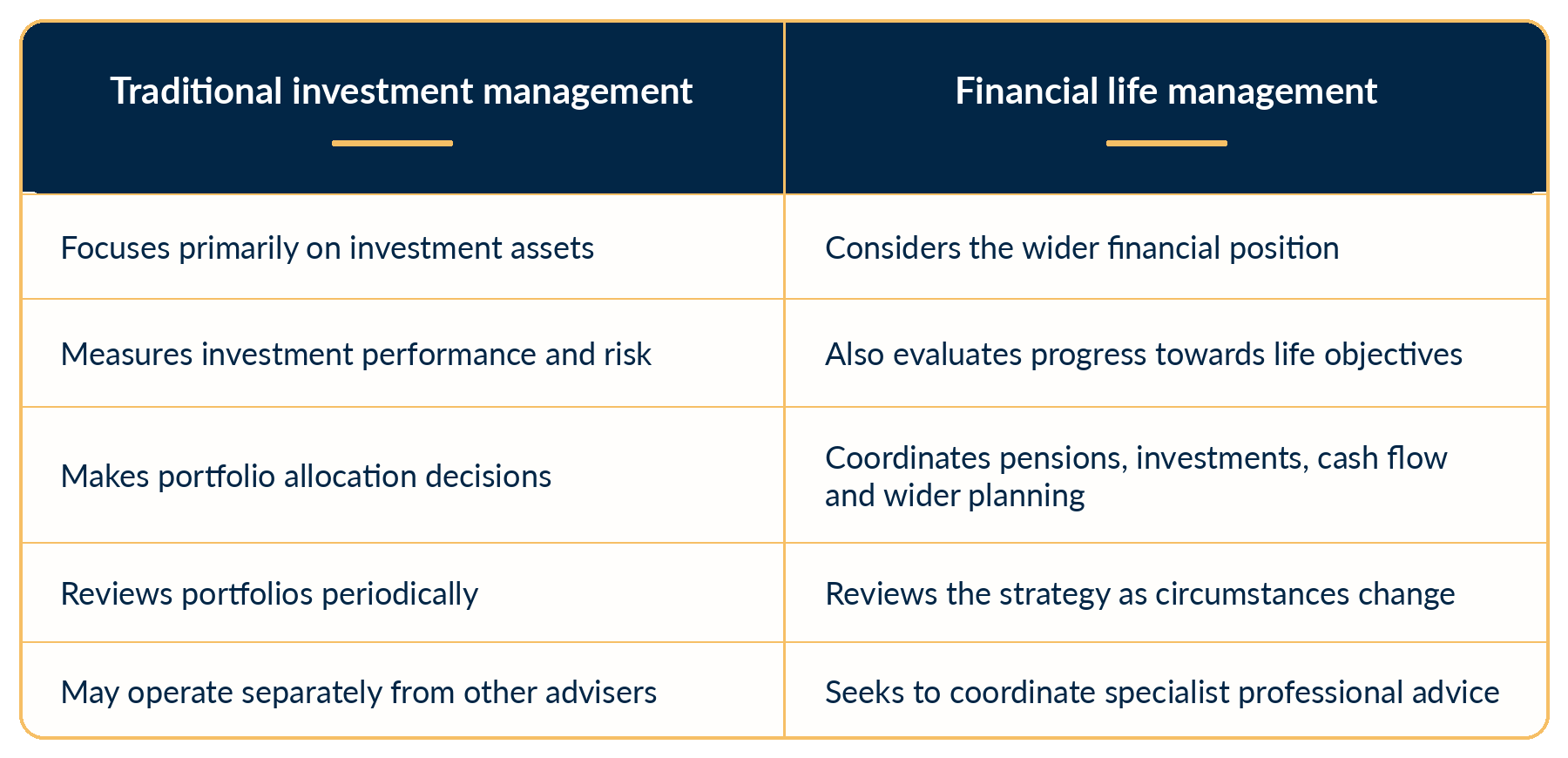
Financial life management does not replace investment management. It places it within a broader strategy.
What Financial Life Management Covers
There is no single formula for managing a complex financial life.
The precise priorities will depend on your circumstances, the nature of your wealth, your family and what you are ultimately trying to achieve.
However, there are several important areas that I would ordinarily consider as part of an ongoing financial planning relationship.
Investment strategy and wealth management
Investment portfolios should be constructed around your objectives, time horizon, capacity for risk and need for liquidity.
My investment approach is evidence-based, emphasising asset allocation, diversification, appropriate risk management and controlling unnecessary costs.
Where assets are held across different accounts, pensions and investment structures, I consider the combined allocation rather than treating each portfolio in isolation.
This can help identify unintended concentrations, overlapping investments, excessive costs or inconsistent investment strategies.
Retirement income and cash-flow planning
For many clients, the transition from accumulating wealth to drawing an income represents one of the most significant financial decisions of their lives.
The objective changes from maximising accumulated wealth to ensuring that available resources can support their desired lifestyle over time.
I help clients evaluate retirement income needs, pension withdrawal options, the appropriate balance between growth and defensive assets, and the interaction between pensions, cash reserves and other investments.
Cash-flow modelling can help assess whether planned expenditure is sustainable and how different retirement choices may affect long-term financial security.
Tax-efficient wealth structuring
How investments and pensions are held can be just as important as the investments themselves.
The appropriate combination of pensions, ISAs, general investment accounts, investment bonds and other structures will depend on individual circumstances.
I consider tax efficiency as part of the wider planning strategy, including how assets may be accessed, transferred or passed to beneficiaries.
Where specialist tax advice is required, I coordinate with suitably qualified tax professionals rather than attempting to replace their role.
Family wealth and succession
Wealth often has a purpose beyond the individual who accumulated it.
You may wish to help children purchase homesfund education, provide for vulnerable family members or transfer assets to future generations.
The challenge is to balance generosity with , your own financial security and the need to retain sufficient resources throughout retirement.
I help clients examine the financial consequences of gifting, inheritance planning and succession arrangements, working alongside legal and tax professionals where appropriate.
Borrowing, Mortgages and Lombard Lending
Borrowing can also form an important part of your wider financial strategy.
Whether you are arranging a residential mortgage, financing a property purchase or considering Lombard lending secured against an investment portfolio, the key is to ensure that any borrowing complements your overall financial position.
I help clients assess how different financing arrangements fit alongside their investments, cash flow, liquidity requirements and long-term objectives. This includes considering borrowing costs, repayment flexibility, interest rate exposure and the risks associated with using investments as collateral, particularly where market falls could trigger additional security requirements or forced asset sales.
Where specialist lending advice is required, I can coordinate with appropriate mortgage brokers, private banks and lending specialists to ensure that borrowing decisions form part of a coherent financial strategy rather than being considered in isolation.
International and cross-border financial planning
For internationally connected individuals, financial decisions can become particularly complicated.
A pension established overseas, a property in another country, an investment bond or a planned change of tax residence may introduce issues that are not apparent when considering each arrangement separately.
My experience advising internationally mobile clients is particularly relevant where UK financial planning interacts with overseas assets, pension arrangements, residency or succession rules.
International considerations require careful examination of the relevant jurisdictions and, where necessary, coordination with locally qualified specialists.
Bringing the right professionals together
One of the most valuable aspects of financial life management is coordination.
Your accountant may be preparing for one tax outcome while your investment arrangements are structured with a different objective in mind. Your estate planning may have been prepared years before significant changes to your assets or family circumstances.
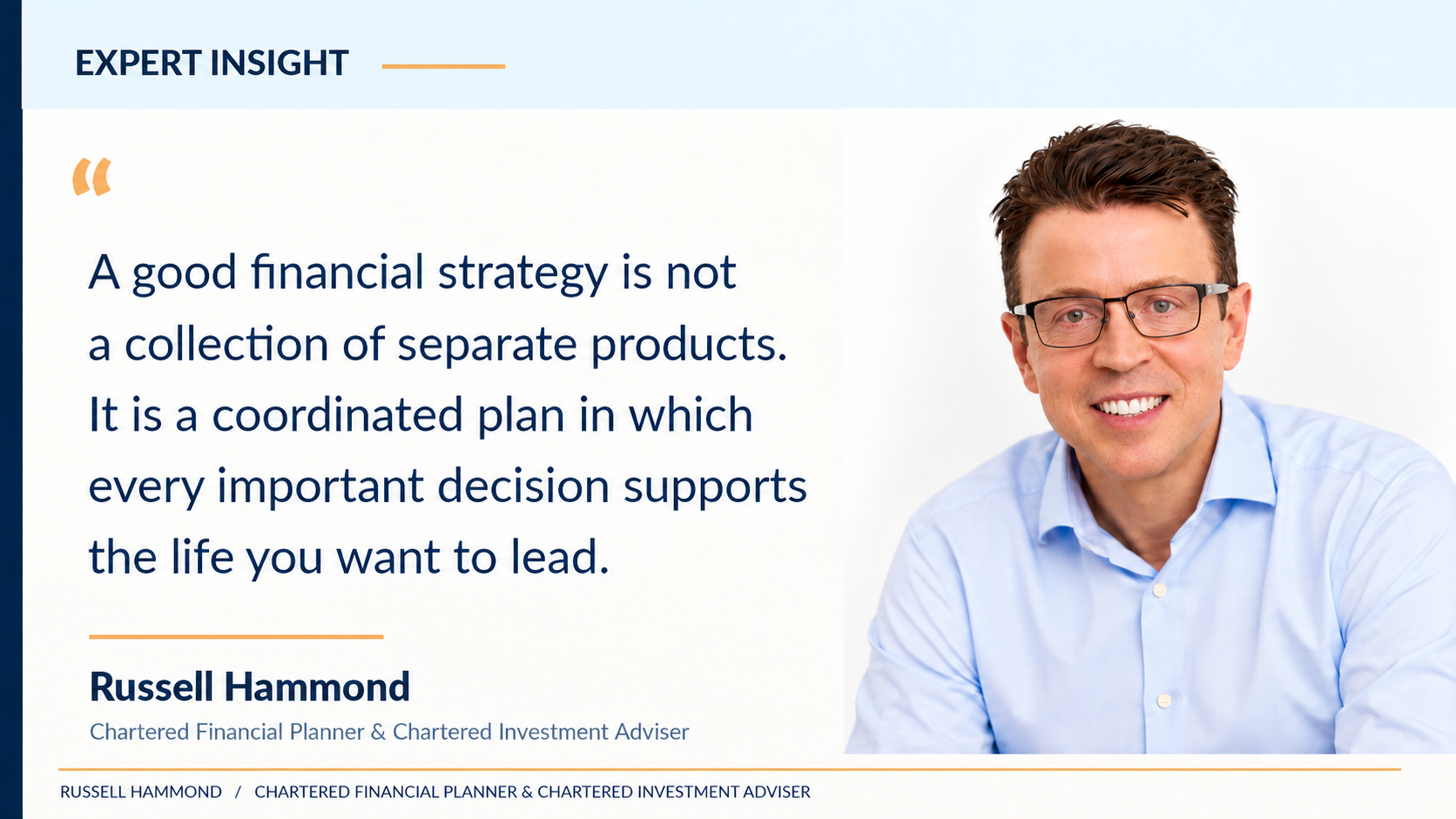
By taking an overarching view, I can identify where decisions should be considered together and help ensure that relevant advisers are working towards the same objectives.
I remain your financial planning adviser and central point of contact for the strategy, while each specialist retains responsibility for their own professional advice.
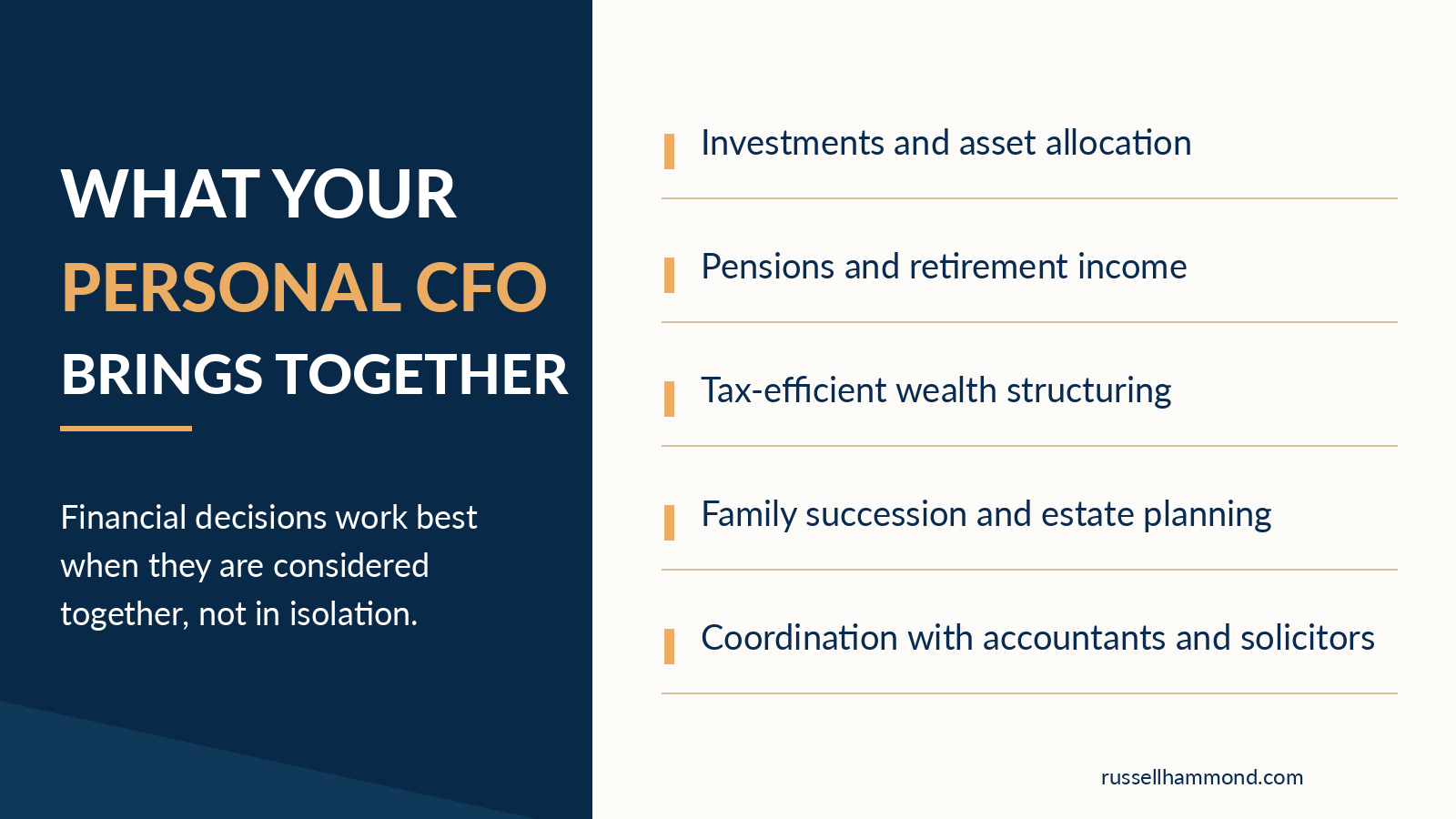
The Five Areas That Need to Work Together
Who Benefits Most From Financial Life Management?
Financial life management is particularly valuable when financial circumstances have become too complex to manage comfortably through a series of unrelated decisions.
In my experience, the people who benefit most are not necessarily those with the largest investment portfolios. They are those whose financial decisions have become increasingly consequential.
Individuals approaching or enjoying retirement
Retirement is rarely just about choosing when to stop working.
It involves deciding how to finance a desired lifestyle, how much investment risk to retain, how to structure withdrawals and what to do with wealth that may ultimately be left to others.
Having a coherent retirement income strategy can help turn financial assets into greater certainty about the choices available.
Business owners and entrepreneurs
Running a successful business creates financial opportunities, but also introduces complexity.
Business income, investments, company pension contributions, eventual succession and potential business sales may all interact.
For business owners, personal financial planning should be coordinated with commercial objectives, available liquidity and the eventual transition from business ownership to personal financial independence.
Senior executives and professionals
High-earning professionals may accumulate pensions, employee share awards, deferred compensation, investments and property over the course of their careers.
Their financial circumstances can be particularly sensitive to changes in employment, earnings, tax rates or retirement plans.
An integrated strategy can help ensure that wealth accumulated during high-earning years is managed appropriately for the longer term.
Internationally mobile individuals and families
Moving between countries can change the rules governing taxation, pensions, inheritance and investment arrangements.
For people who have spent much of their careers overseas, returning to the UK may require a substantial reassessment of their financial affairs.
Individuals with substantial or complex family wealth
As wealth grows, questions about family support, inheritance, trusts, property and succession can become more important.
The objective is not necessarily to create more complicated financial structures.
Often it is quite the opposite: to simplify existing arrangements, clarify responsibilities and ensure that wealth is managed in a way that reflects personal and family priorities.
Financial Life Management Is Also About Avoiding Unnecessary Complexity
A point that is sometimes overlooked in wealth management is that complexity is not automatically a sign of sophistication.
Having several investment platforms, multiple advisers and a collection of financial products does not necessarily improve financial outcomes.
In fact, unnecessary complexity can make it more difficult to understand your financial position, assess costs or make timely decisions.
Part of my role is to identify when existing arrangements can be simplified.
That might involve consolidating investments, reviewing outdated pensions, reducing overlapping holdings, establishing clearer reporting or determining whether complex structures still serve a useful purpose.
The objective is not consolidation for its own sake. Sometimes retaining separate arrangements is sensible because they offer valuable benefits, diversification or different tax treatment.
The important question is whether every element of the financial structure has a clear purpose.
A well-organised financial life should be easier to understand, not more difficult.
How I Work as Your Personal Financial CFO
I see financial life management as an ongoing relationship rather than a one-off exercise.
The work begins with understanding your current position, but its value continues as your circumstances and objectives evolve.
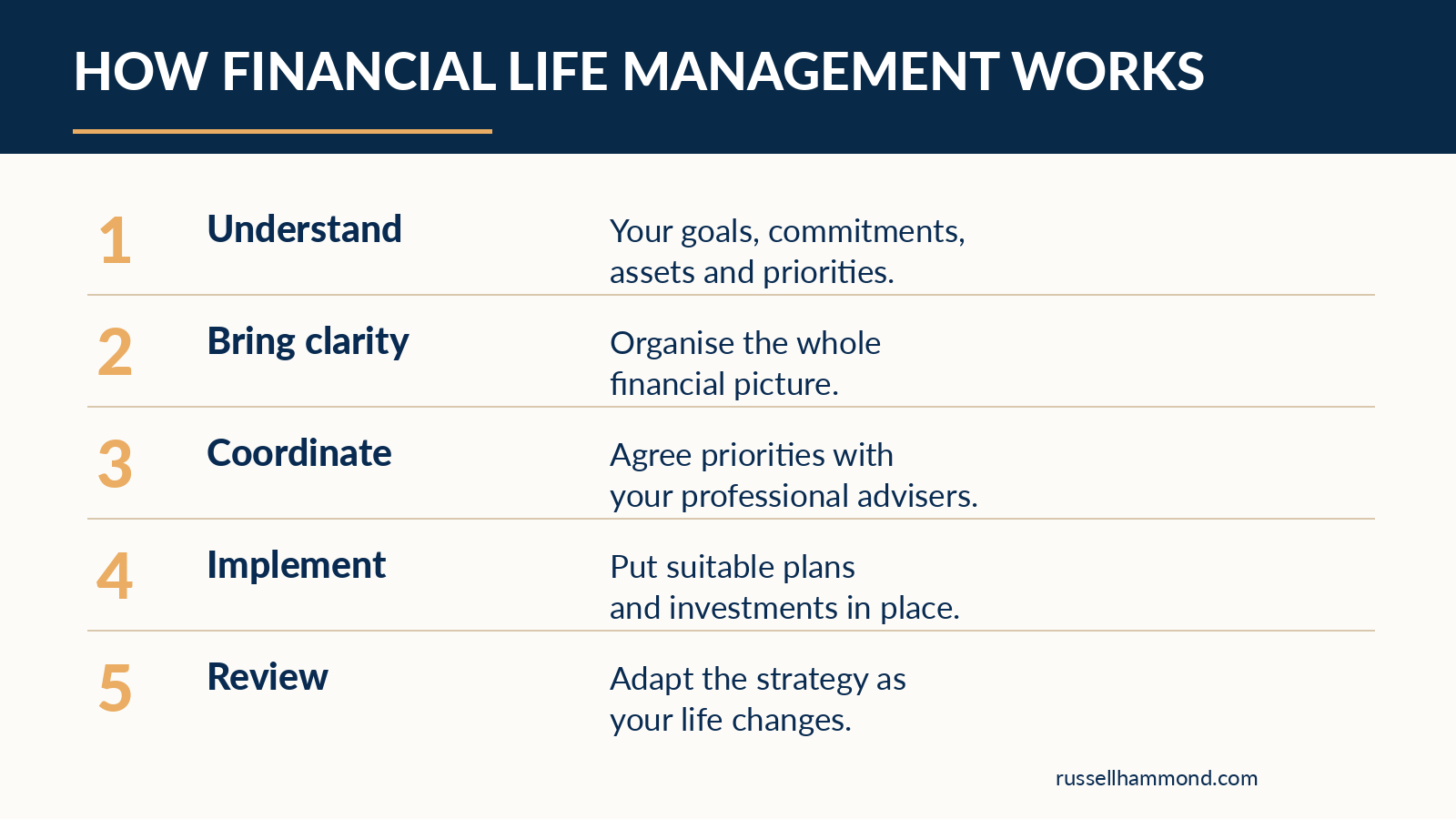
Understanding what matters to you
Before making financial recommendations, I want to understand your wider circumstances.
That includes your existing assets and liabilities, income, expenditure, family commitments, risk preferences and future plans.
Perhaps you want to retire early, reduce working hours, move abroad, help your children financially or simply feel more comfortable spending the wealth you have accumulated.
These objectives provide the context for the financial strategy.
Bringing clarity to your existing arrangements
The next step is to assess how your finances are currently organised.
I consider pensions, investments, cash reserves, existing financial structures and the wider planning position.
Where appropriate, financial modelling helps establish whether existing arrangements are aligned with your objectives and identifies areas that may require attention.
Developing and coordinating your strategy
I then develop suitable recommendations and establish which actions should take priority.
Some decisions may involve changes to investments or pensions. Others may require input from your accountant, solicitor or another specialist.
Where appropriate, I help coordinate that input so decisions are considered in the context of your overall objectives.
Implementing agreed recommendations
A financial strategy only becomes valuable when appropriate actions are taken.
I help arrange and oversee the implementation of recommendations within the scope of my advice, working with relevant providers and professional advisers as necessary.
Not every recommendation requires changing a product or transferring an investment.
Sometimes the correct decision is to retain an existing arrangement.
Reviewing and adapting the plan
Your financial circumstances will change. So will markets, legislation, family requirements and your own priorities.
Regular reviews help ensure the strategy remains appropriate.
For my ongoing clients, I normally work to a structured six-monthly review cycle, supplemented by contact when significant circumstances or decisions require attention.
The objective is continuity: having an adviser who understands the history behind your arrangements and can help you respond when something important changes.
How Financial Life Management Works
The Value of Having One Trusted Financial Adviser
There is a considerable difference between receiving financial advice when you ask for it and having an ongoing adviser who understands your circumstances in depth.
The longer an advisory relationship continues, the more context the adviser can develop.
Decisions about your finances are no longer considered in isolation. They can be assessed against your previous choices, your current financial position and the objectives you have discussed over time.
That continuity can be particularly valuable during major life events.
A business sale, inheritance, change of residence, retirement decision or family bereavement can create several interconnected financial issues.
Instead of approaching each question without an established strategy, you have someone familiar with your circumstances who can help determine what requires attention and which specialists should be involved.
This is the aspect of financial planning that I find especially rewarding.
Over more than 20 years as a financial adviser, I have come to appreciate that the most valuable client relationships are rarely defined by a single investment recommendation.
They develop through years of discussion, planning, implementation and adjustment as clients move through different stages of their lives.
It is that longer-term perspective that I aim to bring to every ongoing client relationship.
Is Financial Life Management the Same as a Family Office?
There is some overlap, but the two services are not identical.
A traditional family office may provide extensive administrative, investment, reporting, governance and other services for a family with substantial wealth, often involving a dedicated team.
Financial life management can provide some of the strategic coordination that makes a family-office relationship valuable without necessarily requiring that level of infrastructure.
For clients whose needs justify a more extensive family-office structure, additional specialist services may be appropriate.
My role is primarily one of strategic financial planning and investment advice, together with coordination of the relevant professional input.
It is not a promise to provide every legal, tax, accounting or administrative service personally.
What Should You Expect From Financial Life Management?
An effective relationship should ultimately provide three things.
Clarity: An understanding of your financial position, what your wealth can support and the decisions that matter most.
Coordination: A coherent strategy in which investments, pensions, taxation, family objectives and other professional advice are considered together.
Continuity: An ongoing relationship with an adviser who understands your financial history and helps adapt your strategy as circumstances change.
None of these outcomes can eliminate uncertainty or guarantee investment performance.
But they can improve the structure and consistency of financial decision-making.
And for someone who has spent decades accumulating wealth, that can be every bit as valuable as the individual investment decisions made along the way.
Your Wealth Should Support Your Life
Successful financial planning is not simply about accumulating the largest possible portfolio.
It is about understanding what your wealth is for.
For some, that means financial independence and the ability to stop working.
For others, it means supporting family, pursuing interests, relocating, giving money away or creating a lasting legacy.
The purpose of financial life management is to connect those objectives with the financial decisions required to pursue them.
My role is to help bring the various elements together, provide ongoing guidance and make sure that the broader strategy remains focused on what matters to you.
Because ultimately, your financial life should be organised around the life you want to lead, not the other way around.

Frequently Asked Questions
What is financial life management?
Financial life management is an integrated approach to personal financial planning that considers investments, pensions, retirement income, tax efficiency, family wealth and other significant financial decisions together. Rather than treating each arrangement separately, the objective is to create a coherent long-term strategy around your circumstances and goals.
What does a personal financial CFO do?
A personal financial CFO acts as a central financial planning adviser, helping assess your overall financial position, identify priorities, coordinate investment and retirement strategies and work with accountants, solicitors and other specialists where required. The role is strategic coordination and ongoing financial advice rather than replacing the specialist services provided by those professionals.
How is financial life management different from wealth management?
Traditional wealth management often concentrates on investment portfolios, asset allocation and investment performance. Financial life management includes those areas but extends to retirement planning, cash flow, succession, tax-efficient structuring and coordinating decisions across the wider financial picture. The exact scope will depend on the services agreed with your adviser.
Who benefits most from financial life management?
Financial life management is particularly valuable for individuals approaching or enjoying retirement, business owners, senior executives, internationally mobile families and people with substantial or complex financial arrangements. The need is usually driven by the number and importance of interconnected financial decisions rather than simply the amount of wealth held.
Can my financial adviser coordinate with my accountant and solicitor?
Yes. Where appropriate, and with your permission, a financial adviser can work alongside accountants, solicitors and other specialists to help ensure financial recommendations are consistent with the wider strategy. Each professional remains responsible for advice within their own area of expertise, including legal and specialist tax advice.
Continue reading
Want to Change Your RL360 Adviser or Get a Second Opinion?
If you hold an RL360 investment bond and are considering changing financial adviser, you’re not alone. Many RL360 policyholders originally established their bond years ago, often whilst living [...]
Momentum QROPS: A Guide to Your Pension, Changing Adviser and Retirement Planning
If you hold a Qualifying Recognised Overseas Pension Scheme (QROPS) with Momentum Pensions, you may have established your pension many years ago, perhaps while living and working overseas. Since [...]
Are Trusts Still the Best Tool for Inheritance Tax Planning?
Trusts are often seen as the gold standard for inheritance tax planning—but are they really the most effective or efficient tool? In this article, we unpack the hidden costs, [...]