Friends Provident International Offshore Bond: Changing Adviser, Charges and Returning to the UK

Key takeaways
Key Takeaways
- You can normally change adviser without surrendering your existing Friends Provident International bond. The process will depend on your policy and the provider’s requirements.
- FPI no longer accepts new UK offshore bond business, but existing policies continue to be serviced.
- Returning to the UK does not automatically mean your offshore bond should be surrendered. Its tax treatment, investment structure and future role should be reviewed.
- Charges and surrender terms vary between policies. Older arrangements may have different charging structures, investment options and restrictions.
- An existing FPI bond can form part of wider financial planning, including retirement income, tax-efficient withdrawals, estate planning and investment management.
If you already hold a Friends Provident International (FPI) offshore investment bond, you may be wondering whether your existing arrangement remains appropriate, particularly if you’re returning to the UK, reviewing your investments or looking to appoint a new financial adviser.
The good news is that changing adviser does not ordinarily mean surrendering your existing bond or transferring your investments to a different provider.
I’ve advised internationally mobile individuals and families for more than 20 years, including clients with existing Friends Provident International arrangements. In many cases, the starting point is simply to understand what you already have and establish whether it continues to meet your objectives.
In this guide, I’ll explain how changing adviser works, what to consider when reviewing an FPI bond and why returning to UK tax residence makes careful planning particularly important.
Can You Change Adviser on an Existing Friends Provident International Bond?
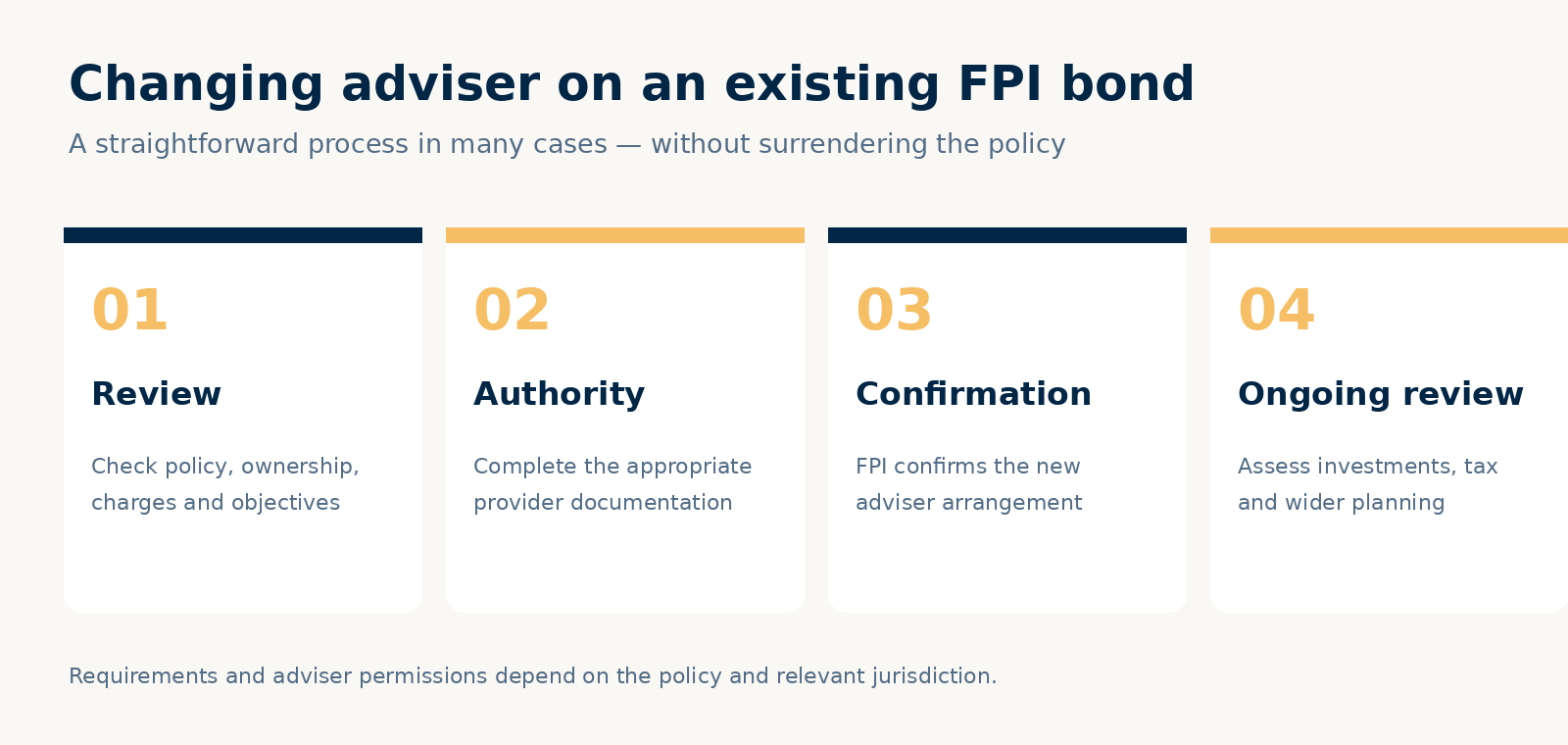
Yes. In many cases, an existing Friends Provident International policyholder can appoint a new financial adviser without surrendering the bond.
The precise process depends on the policy, the type of adviser appointment and the provider’s administrative and regulatory requirements.
For a straightforward case, the process may involve completing a letter of authority or other provider documentation, allowing the new adviser to obtain policy information and establish the appropriate servicing arrangements.
It is important to distinguish between:
- Authority to obtain information: allowing an adviser to request details about your existing policy.
- Appointment as servicing adviser: establishing the adviser relationship recognised by FPI.
- Investment authority: any separate permissions required to give instructions or manage underlying investments.
These are not necessarily the same thing.
The objective should be to preserve an appropriate existing arrangement wherever possible, rather than recommend unnecessary product changes simply because you are appointing a new adviser.
A Recent Example: Taking Over an Existing £800,000 FPI Bond
I recently helped a British couple who were living in Singapore and preparing to return to the UK.
They already held a Friends Provident International offshore bond worth approximately £800,000 and wanted an adviser who could support them as their financial circumstances changed.
In this case, the administrative process was straightforward. The necessary authority was arranged, allowing me to become involved with their existing policy without requiring the bond to be surrendered or replaced.
This is a useful illustration of an important point: appointing a new adviser does not automatically mean starting again with a new investment product.
Naturally, every arrangement is different. The appropriate next steps depend on the existing policy, its charges, the client’s objectives and the tax implications of any proposed changes.
What Happens to an FPI Offshore Bond When You Return to the UK?
Returning to the UK is one of the most important reasons to review an existing offshore investment bond.
An arrangement that was suitable while you were living in Singapore, Dubai or another international jurisdiction may still be appropriate after your return. However, your UK tax residence can materially affect how withdrawals and chargeable event gains are treated.
The key point is that returning to the UK does not automatically require you to surrender an offshore bond.
Before making changes, I would ordinarily review several areas.
UK Tax Residence and Chargeable Event Gains
Gains arising from offshore investment bonds are generally subject to the UK chargeable event regime and may be liable to income tax rather than capital gains tax.
The timing of withdrawals or surrender can therefore be significant, particularly when a client is moving between tax jurisdictions.
A large withdrawal made without proper planning could produce a very different tax outcome from a carefully structured series of withdrawals.
Time-Apportioned Reduction
Where the relevant conditions are met, time-apportioned reduction may reduce the UK-taxable element of a chargeable event gain to reflect qualifying periods of non-UK residence.
The calculation depends on factors including the policy’s commencement date, the residence history of the person liable to tax and the applicable legislation.
It is not simply a case of assuming that gains accumulated overseas will automatically escape UK taxation.
For someone who has held an FPI bond throughout a lengthy period overseas, this can be an important consideration when planning withdrawals or surrender.
The 5% Tax-Deferred Withdrawal Allowance
Certain offshore investment bonds allow withdrawals of up to 5% of the original premium per policy year, with unused allowances generally carried forward, subject to the cumulative limit and relevant rules.
This is a tax-deferral mechanism, not a tax exemption.
Withdrawals within the available allowance may avoid an immediate chargeable event gain, but they are normally taken into account when the bond is ultimately surrendered or another relevant chargeable event occurs.
Understanding the available allowance, previous withdrawals and policy segmentation can help inform a sensible withdrawal strategy.
Top-Slicing Relief
Where a chargeable event gain causes an individual to move into a higher income tax band, top-slicing relief may reduce the resulting tax liability.
The availability and calculation of this relief depend on the circumstances, including the policy history and any relevant periods of non-UK residence.
This is another reason to obtain advice before making a substantial withdrawal or surrendering an existing policy.
Friends Provident International Bond Charges: What Should You Review?
Charges are one of the first things I examine when reviewing an existing offshore investment bond.
Friends Provident International has offered different products and charging structures over time. Consequently, two clients with FPI policies may have very different arrangements.
A meaningful review should consider the total cost of ownership rather than focusing on a single headline charge.
Areas to examine include:
- Policy administration charges: the contractual charges applied by the provider.
- Initial or establishment charges: including any remaining charges associated with the original arrangement.
- Investment and fund charges: the costs of the underlying investment holdings.
- Adviser remuneration: any ongoing adviser fees or historical commission arrangements.
- Dealing and transaction costs: where applicable.
- Surrender terms: any early exit penalties or other restrictions.
An older policy is not necessarily a poor policy. Equally, the fact that a bond has been held for many years does not automatically mean its charges remain competitive.
The important question is whether the existing arrangement continues to offer appropriate value, investment flexibility and tax-planning benefits.
Should You Keep, Change or Surrender Your Existing FPI Bond?
This is rarely a decision that should be made on charges alone.
An offshore bond may continue to offer useful financial planning advantages, particularly where there is an established policy history, a significant accumulated withdrawal allowance or relevant tax considerations.
On the other hand, there may be circumstances where the policy’s investment restrictions, charges or longer-term suitability warrant a more substantial review.
Before recommending a course of action, I would normally consider:
- The bond’s current value and original investment.
- The available withdrawal allowance and previous chargeable events.
- The policy’s surrender value and any applicable penalties.
- The underlying investments and overall portfolio risk.
- The policyholder’s current and expected future tax residence.
- Ownership arrangements, beneficiaries and estate-planning objectives.
- Whether the bond continues to support the client’s wider financial plan.
Sometimes the most appropriate recommendation is to retain the existing bond and improve the investment or servicing arrangements.
Sometimes it is to make changes gradually.
And occasionally, surrender or replacement may be appropriate, but only after considering the costs and tax consequences.
Friends Provident International Reserve, Reserve+ and Other Existing Policies
Friends Provident International has offered a range of international investment and life assurance products, including Reserve and Reserve+.
It also has legacy UK offshore bond arrangements, including products such as Reserve Advance and the Succession Planning Bond.
The availability, investment options, charging terms and contractual features differ between products and policy versions.
FPI stopped accepting new UK offshore bond business some time ago, although existing policies continue to be serviced.
Consequently, when reviewing an existing policy, it is important to work from the actual policy documentation rather than assume that the terms of one FPI product apply to another.
How I Approach an Existing FPI Bond Review

My approach begins with understanding your existing arrangements and what you want your wealth to achieve.
I don’t believe that taking over an existing investment bond should automatically lead to a recommendation to replace it.
Instead, I consider the bond as part of your wider financial circumstances.
This may include reviewing your investment portfolio, the costs of your existing arrangement, future income requirements, tax residence, pension assets, estate planning and longer-term financial objectives.
Where appropriate, I use cash-flow modelling to illustrate how your investments and other assets could support your future spending needs.
The objective is not simply to manage an offshore bond. It is to make sure the bond continues to serve a useful purpose within your financial life.
Financial Planning for British Expatriates Returning to the UK
Returning to the UK often involves considerably more than deciding what to do with an offshore bond.
You may also need to consider overseas pensions, UK pension arrangements, investment accounts, cash deposits, property, inheritance tax exposure and the timing of income or capital withdrawals.
These decisions are interconnected.
For example, withdrawing money from an offshore bond to fund expenditure may have a different tax impact from drawing on cash reserves, pensions or other investments.
A coordinated financial plan can help establish which assets should be used, when and why.
Having worked extensively with internationally mobile clients, I understand the importance of planning around changes in residence rather than treating each investment or pension arrangement in isolation.
Where advice involves overseas residents, the availability and scope of regulated services will depend on the relevant jurisdiction and applicable permissions.
Considering a New Adviser for Your Friends Provident International Bond?
If you already hold a Friends Provident International offshore bond, I can help you explore whether your existing arrangement remains appropriate and what may be involved in appointing a new adviser.
That might mean reviewing an established policy, preparing for a return to the UK, assessing investment costs or considering how the bond fits into your wider retirement and estate planning.
In some cases, the administrative process of changing adviser can be relatively straightforward.
The more important work is ensuring that the arrangement continues to support your financial objectives.
If you would like to discuss your existing FPI bond, I would welcome the opportunity to arrange an initial consultation.
Frequently Asked Questions
Can I change adviser on my existing Friends Provident International offshore bond?
Yes, normally. Depending on the policy and FPI's requirements, you may be able to appoint a new adviser without surrendering or transferring your bond. The process may involve a letter of authority and separate adviser appointment documentation.
What happens to my FPI offshore bond when I return to the UK?
Your bond can generally continue after you become UK tax resident, but its tax treatment and suitability should be reviewed. Chargeable event gains, time-apportioned reduction, withdrawal allowances and your wider financial circumstances may all be relevant.
Does Friends Provident International still accept new UK offshore bond business?
No. Friends Provident International stopped accepting new UK offshore bond business in November 2015. However, it continues to service existing policies, and existing policyholders may still be able to appoint a new adviser.
Should I surrender my FPI bond if its charges are high?
Not necessarily. Before surrendering an existing offshore bond, it is important to review the full charging structure, surrender penalties, investment options and potential tax consequences. Retaining and improving the existing arrangement may sometimes be more appropriate.
Can you help with an FPI bond held while living in Dubai?
I have extensive experience working with internationally mobile clients, including people returning to the UK or currently living in the UAE. I can help assess existing FPI arrangements and their place within wider financial planning. The availability and scope of regulated advice depend on the client's jurisdiction and applicable permissions.