Are Financial Advisers Worth Their Fees? The Numbers and the 3am Test

Key takeaways
- Advisory fees should be assessed against the entire financial outcome, compared with a realistic DIY or alternative-adviser approach.
- Vanguard, Dimensional, Morningstar and Fidelity have all produced useful research on the value of financial planning, but none establishes a universal guaranteed annual return from advice.
- On a hypothetical £4 million portfolio, reducing total annual costs by 0.6 percentage points initially saves £24,000 a year, with an illustrative £874,000 difference over 20 years.
- Effective withdrawal planning, succession arrangements, tax-efficient structures and appropriate borrowing decisions can materially affect a family’s after-tax wealth.
- Lombard lending can preserve investment exposure and defer a taxable sale, but interest costs, margin calls and potential losses must be carefully assessed.
- Good financial planning should deliver more than numbers: confidence, clarity, better decisions and fewer sleepless nights.

Financial advice costs money. On a substantial investment portfolio, those fees can amount to thousands — sometimes tens of thousands — of pounds each year.
So it is entirely reasonable to ask: does a financial adviser create more value than they charge?
I believe a good adviser should be able to demonstrate that value. But I also think the financial advice industry has sometimes answered the question too narrowly, by concentrating on investment returns or by repeating claims that advisers can add a particular percentage each year.
That misses the point.
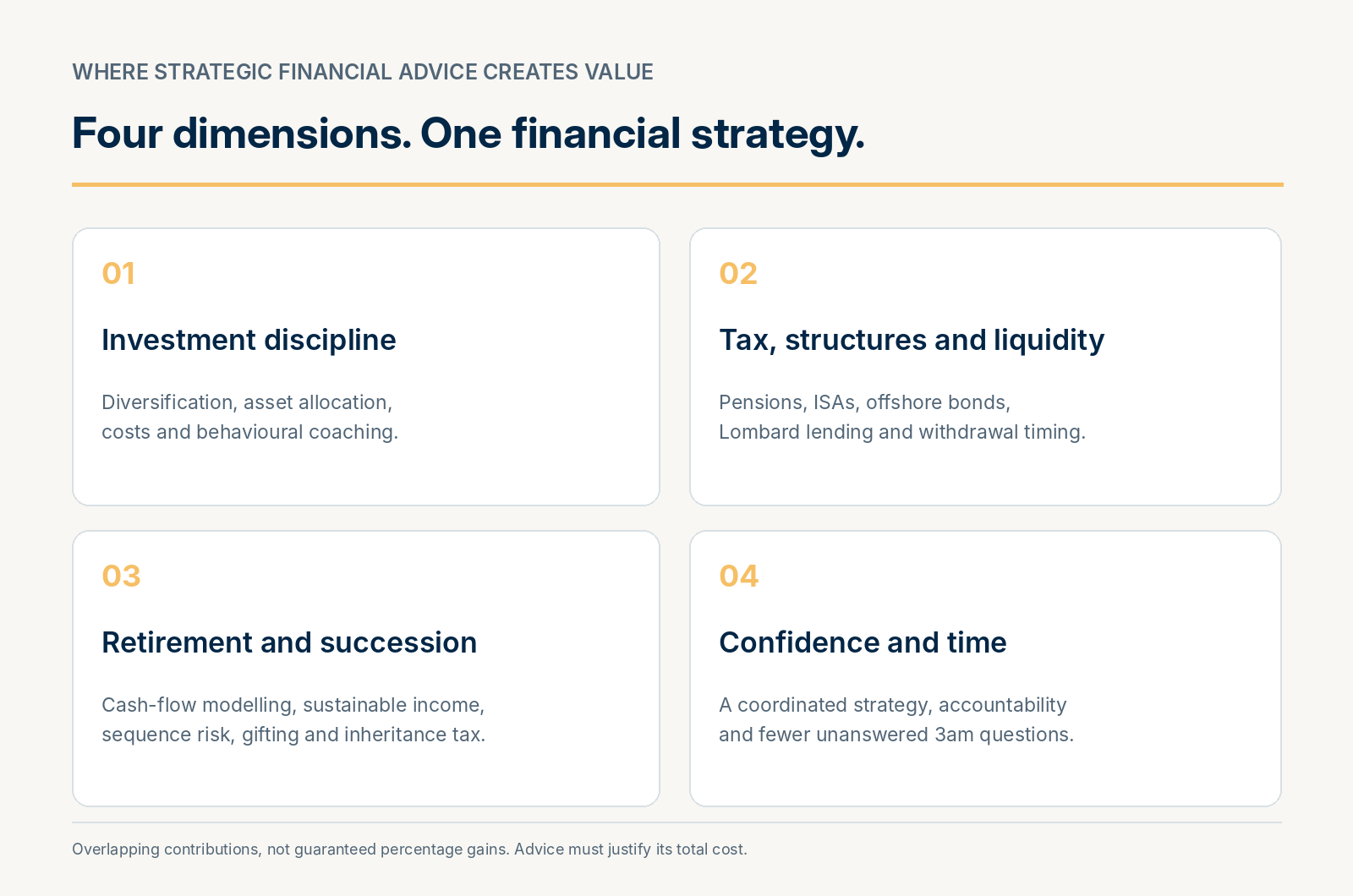
The most valuable advice I give is not always about which investments to hold. It can be about when to retire, which assets to draw upon first, how to avoid unnecessary tax, whether to borrow against investments rather than sell them, how to help children without compromising your own future, or how to respond when markets fall sharply.
Some decisions produce measurable savings. Others reduce the risk of an expensive mistake. And some allow people to enjoy the wealth they have spent decades building.
There is also a less tangible question: who is helping you avoid the 3am moment when you wake up worrying whether you are going to be all right?
This article examines the research, tests some of the numbers and compares strategic financial planning with doing everything yourself.
I use a £4 million portfolio for several illustrations, but the principles apply just as much to people with £1 million or £10 million: the amounts change, while the underlying decisions remain important.
The Wrong Way to Measure a Financial Adviser’s Value
Suppose your financial adviser charges 1% a year on a £4 million portfolio. That is £40,000 annually in adviser fees, before any additional fund or platform charges. It is a meaningful cost and deserves scrutiny.
One approach is to ask whether the adviser delivered an extra 1% of investment performance. But this sets the wrong test. A diversified portfolio can be bought and managed relatively cheaply, and consistently beating the market is not a realistic promise.
A better test is to compare the entire outcome with the realistic alternative: what you would have done without advice. That includes investment costs, taxes, borrowing, behaviour, retirement decisions, estate planning, time and confidence.
The starting point matters. An informed DIY investor with a simple financial position may need relatively little ongoing advice. Someone approaching retirement with several pensions, investments, an offshore bond, business interests and inheritance concerns may have much more to gain.
The question is not whether all financial advisers add a fixed amount of value. It is whether the right advice, for the right person, at the right time is worth more than its total cost.
What the Research Says — and What It Does Not Say
Vanguard: The Frequently Quoted 3%
Vanguard’s UK research on Adviser’s Alpha estimates that advisers following certain wealth-management best practices can add up to, or exceed, 3 percentage points in additional net return in Vanguard’s model.
Its framework covers asset allocation, investment selection, rebalancing, behavioural coaching, asset location and tax-efficient retirement strategies.
This is not a guaranteed 3% every year, nor an amount that applies to every investor. The research concerns potential benefits that are often uneven and depend on the starting point. Vanguard expressly says results depend on circumstances and that substantial benefits often arise at irregular moments, such as when an investor avoids a costly reaction to market turmoil.
A separate Vanguard study on personalised advice used four hypothetical client cases to illustrate modelled annualised values of between 0.83% and 2.85%. Again, these are scenario-specific estimates rather than a return uplift any adviser can promise.
Morningstar: Better Retirement Decisions, Not Just Better Investments
Research by David Blanchett and Paul Kaplan at Morningstar examined what it called gamma: the benefit of better retirement planning choices.
In one hypothetical comparison, a more efficient combination of asset allocation, withdrawal strategy, income solutions and tax planning generated 22.6% more certainty-equivalent retirement income than the baseline.
That is a technical measure of the value of retirement-income outcomes and risk — not a claim that clients receive 22.6% more cash each year. The research is useful precisely because it considers decisions beyond investment selection.
Dimensional and Vanguard: Peace of Mind Matters
An analysis of Dimensional’s Global Investor Study found that 39% of older investors selected a sense of security or peace of mind as the primary way they measured the value received from their adviser.
In Vanguard’s research on how investors understand advice, peace of mind was the most frequently cited single reason for seeking it.
These are survey findings, not evidence that advice eliminates financial anxiety. But they challenge the idea that investment performance is all clients are paying for.
Fidelity: The Planning Gap Is Real
Fidelity International’s longevity research, based on a survey of 11,800 people aged over 50 across 13 markets, found that about 36% of pre-retirees were unsure whether their money would last, while just 23% had mapped out their retirement income sources.
That does not establish an investment return attributable to an adviser. It does show why properly understanding retirement income and longevity can matter as much as choosing funds.
These findings use different methods, measures and populations. They cannot be added together to arrive at an annual ‘adviser return’.
Where Financial Advice Can Create Measurable Value
Investment Management, Asset Allocation and Controlling Costs
I favour evidence-based investment management: appropriate asset allocation, broad diversification, risk management and close attention to costs.
A good adviser should help establish how much investment risk you need to take — not simply how much you can tolerate. An investor with sufficient wealth to meet all their objectives may have no reason to accept an unnecessarily aggressive portfolio. Another may require meaningful long-term growth but need to understand what a temporary 25% decline would mean in practice.
Costs are one area where the mathematics is particularly clear.
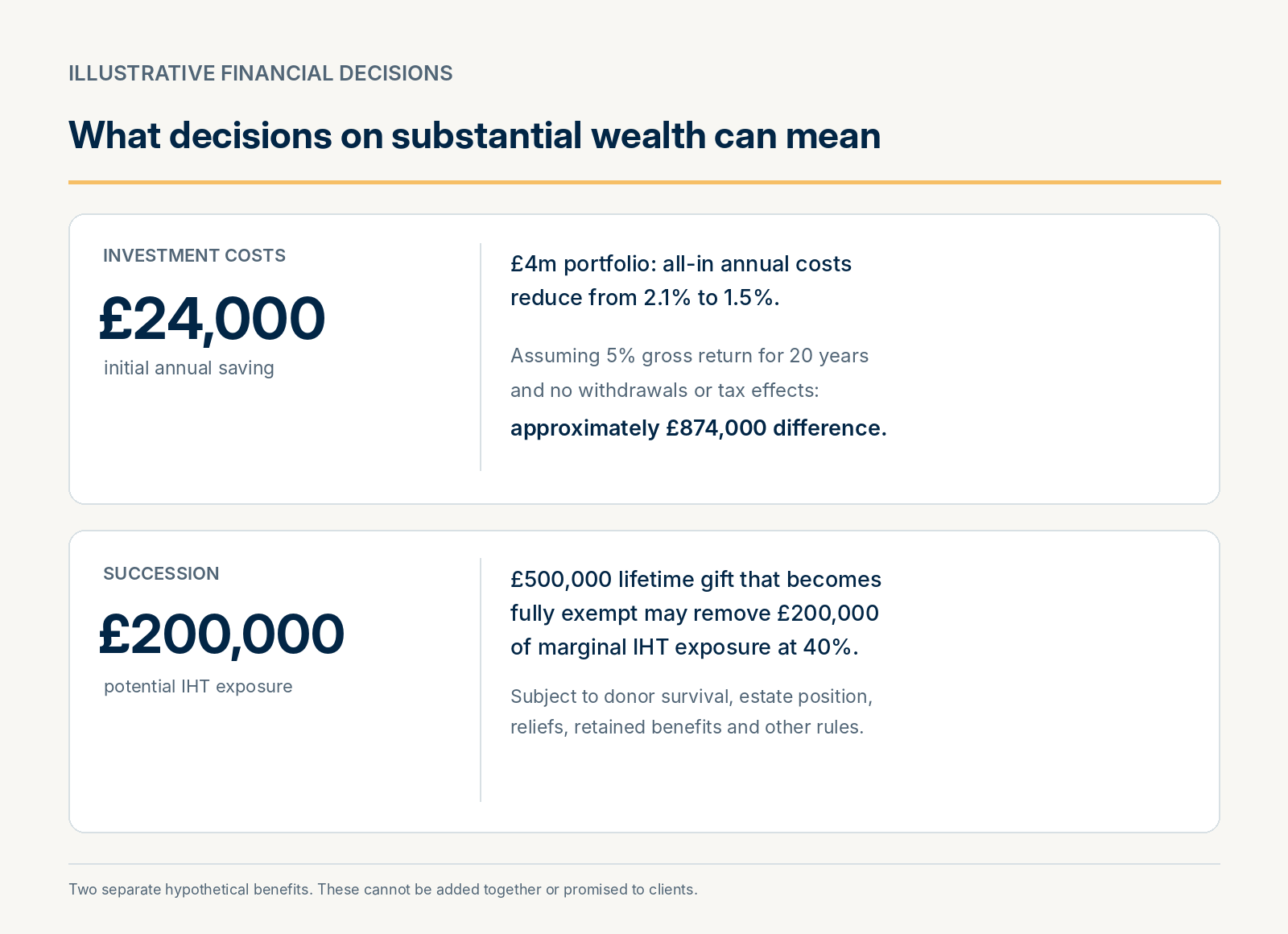
Illustration: Imagine £4 million invested in an arrangement with total annual charges of 2.1%. A review identifies a suitable alternative costing 1.5% all-in, including any ongoing advice charge. The initial reduction is 0.6%, or £24,000 a year on the opening portfolio.
Assuming an illustrative 5% gross annual return, constant percentage charges, no withdrawals, contributions or tax effects, and a 20-year period, the modelled ending values would be approximately:
- Higher-cost arrangement: approximately £7.09 million.
- Lower-cost arrangement: approximately £7.96 million.
- Difference: approximately £874,000.
This is a mathematical example, not evidence that advisers generally offer a cheaper service than DIY investing. Many DIY portfolios are already extremely cost-efficient, while some advised services cost more. Any comparison must include all charges, transaction costs and the tax consequences of switching.
Nor is saving fees the only investment contribution. Portfolio construction, avoiding unnecessary concentration, maintaining liquidity and periodically rebalancing can help keep the risk profile consistent with the financial plan.
Behavioural Coaching: Sometimes the Most Valuable Decision Is Doing Nothing
Markets are unpredictable. Human reactions to them are remarkably familiar.
When markets rise, people become tempted to take more risk. When they fall sharply, they may be tempted to sell precisely when the discomfort is greatest.
On a £4 million portfolio, a 20% decline represents £800,000 on paper and requires a subsequent gain of 25% merely to return to the starting value. Selling after the fall and missing the recovery can crystallise a temporary loss into a permanent one.
I would never argue that an adviser can foresee every market decline or always prevent an investor from making an emotional decision. But setting expectations in advance, agreeing a sensible asset allocation and providing an objective second opinion at difficult moments can be enormously valuable.
That value is episodic. It may not be obvious during five relatively uneventful years, then become especially important over a few turbulent weeks.
Tax-Efficient Wrappers, Investment Structures and Withdrawal Planning
A portfolio’s return is not the same as the amount of money a family keeps after taxes, charges and withdrawals.
Strategic planning means considering where assets should sit: pensions, ISAs, general investment accounts, investment bonds and, when suitable, trust or other family arrangements. It also means understanding the tax implications before money is withdrawn or an asset is transferred. Good planning should also consider capital gains tax arising on sales outside tax shelters.
For example, an offshore investment bond can offer UK tax deferral within the bond structure. Its commonly discussed cumulative 5% withdrawal allowance is tax-deferred, not tax-free. The eventual tax position depends on the circumstances and the chargeable-event rules.
Depending on the policy, partial withdrawals, full surrender of individual segments and assignment of segments can produce materially different tax outcomes. Timing a surrender, considering top-slicing relief or assigning segments by way of gift where appropriate may deserve careful analysis rather than simply withdrawing the requested sum.
A recent conversation with an offshore bond owner brought this home to me: the discussion had initially been about withdrawing money, but it became clear that considering the policy’s individual segments and who might ultimately own them was a much more important planning question.
Not every structure is suitable or produces a saving. Costs, investment restrictions, ownership, taxation, family circumstances and the potential need for specialist tax advice must all be considered together. HMRC’s guidance on gains from foreign life insurance policies illustrates how technical the rules can be.
Lombard Lending: Accessing Liquidity Without Selling Investments
For families with substantial liquid investments, how to fund a major purchase or short-term cash requirement can be as important as how to invest the money.
One option that is often overlooked is Lombard lending, sometimes called investment-backed or securities-backed borrowing. Rather than selling part of a suitable investment portfolio, a borrower pledges eligible investments as collateral and obtains a loan from a private bank or specialist lender.
That can provide liquidity for a property purchase, a temporary cash requirement or a family transaction while leaving the underlying portfolio invested. Where a sale of personally held investments outside a tax shelter would otherwise trigger a chargeable gain, borrowing does not itself constitute that sale, so an immediate capital gains tax liability associated with the disposal may be avoided for the time being.
The accrued gain has not vanished: it may become taxable on a future disposal. Borrowing is not an inheritance tax solution in itself.
Rates are generally quoted as a benchmark plus a lender’s margin and can be competitive for borrowers with substantial, well-diversified eligible portfolios.
It may be possible to negotiate a margin around 1 percentage point above Bank Rate in some circumstances, but that is not a standard entitlement. As a concrete published illustration, Weatherbys Private Bank advertises an indicative margin of 1.48 percentage points above Bank Rate, subject to suitability, alongside a 1% arrangement fee.
The terms available to an individual borrower, the reference rate and the overall cost must be checked at the time.
A Worked Example on a £4 Million Portfolio
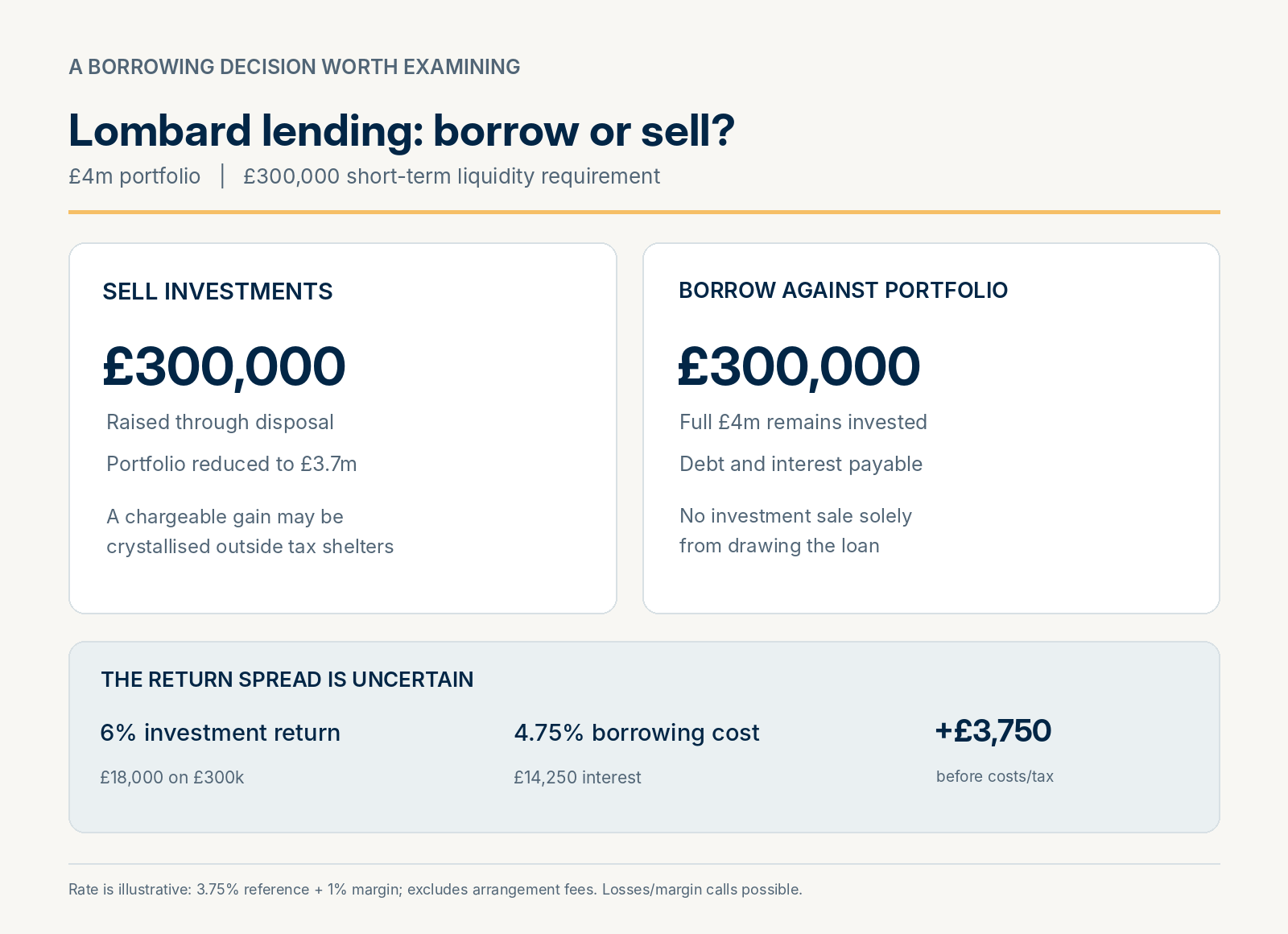
Suppose a family needs £300,000 for a property-related payment. It could sell £300,000 of investments, or it might be able to borrow the sum against its portfolio.
Assume, purely for illustration, that a facility is priced at Bank Rate of 3.75% plus 1.00%, or 4.75% in total, and the investments retained produce a 6% return over the next year.
- By borrowing rather than selling, the additional £300,000 remains invested, producing an assumed £18,000 gross investment return.
- The annual interest at 4.75% on £300,000 is £14,250.
- The mathematical difference is £3,750 in favour of borrowing over selling, before arrangement fees, tax effects, investment charges or changes to the value of the investments.
This is not a risk-free 1.25% enhancement.
If those investments fell 15% instead, maintaining that additional £300,000 exposure would mean a £45,000 investment loss plus £14,250 interest, or £59,250 worse than having sold it, before other costs and tax differences.
The same leverage that can increase net returns can amplify losses.
The 1.00% margin here is hypothetical, not an available quotation. An arrangement fee of 1% of the borrowing would be £3,000, reducing the illustrated first-year positive difference to only £750 if fully charged on that amount.
Actual funding costs may change with interest rates. Some portfolios and securities will not qualify.
Nor can we ignore margin-call risk.
If collateral values fall, the lender may require additional assets or repayment at short notice, and may sell investments if the request is not satisfied. This risk is particularly important in volatile markets.
Borrowing should have a clear purpose, a realistic repayment plan, conservative loan-to-value levels and appropriate liquidity outside the pledged portfolio.
The contribution of an adviser is not to encourage unnecessary gearing. It is to assess whether borrowing is more sensible than selling, using cash or taking alternative finance, and to coordinate the investment, liquidity, borrowing and tax consequences.
For some wealthy families, that can be a genuinely valuable strategic decision; for others, the sensible advice is not to borrow.
Retirement Cash Flow: Protecting Your Future While Enjoying the Present
A financial plan should answer more than ‘What is my portfolio worth?’
It should help answer questions such as: Can I retire two years earlier? What happens if markets fall in the first five years? Can I afford to support my children? What would long-term care costs mean? Could I spend more today without compromising security later?
I use cash-flow modelling to examine the relationship between assets, income, expenditure, inflation, investment risk and longevity. It is not a crystal ball; assumptions need to be realistic, and the model needs updating as life changes.
Importantly, an effective model may reveal that someone is being too cautious. If a client can comfortably afford to travel more, retire earlier or make a gift, the value of advice may be the confidence to do it — not a larger investment balance at death.
Sequence-of-Returns Risk: Why the Order of Investment Returns Matters
Two retirees can earn exactly the same sequence of annual investment returns in different orders and end up with different amounts of money because they are making withdrawals throughout.
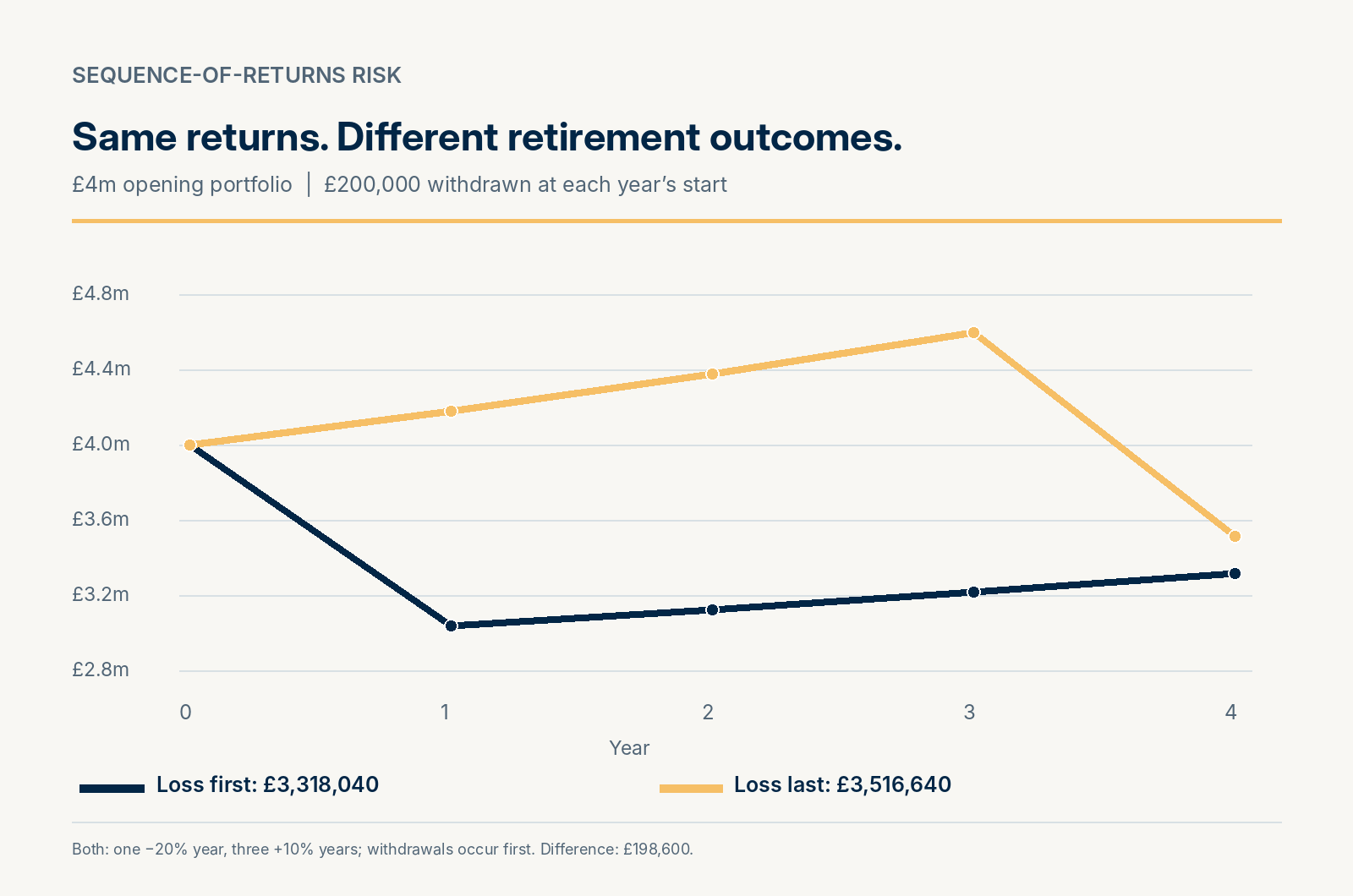
Consider two hypothetical £4 million retirement portfolios. Each withdraws £200,000 at the start of each year, before investment returns, over four years.
Both experience one year at −20% and three at +10%.
- The −20% year comes first: the ending portfolio is approximately £3,318,040.
- The −20% year comes last: the ending portfolio is approximately £3,516,640.
That is a £198,600 difference, despite the same four returns and the same total withdrawals. Without withdrawals, the order of these four returns would not change the final result.
No adviser controls the order of market returns. What planning can do is examine reserve levels, asset allocation, withdrawal sources and flexibility around spending so a household is better prepared for poor returns early in retirement.
Succession Planning and Inheritance Tax
For families with substantial wealth, succession can have very large financial consequences. But effective planning is not simply a competition to minimise inheritance tax.
The first question is how much wealth you need to retain for your own lifestyle and security. The second is how, when and to whom surplus wealth might usefully be transferred.
Illustration: A lifetime gift of £500,000 could eventually reduce an otherwise fully taxable estate by the same amount. At a 40% marginal inheritance tax rate, that represents a potential £200,000 reduction in estate tax exposure.
That is not an automatic £200,000 saving. It assumes the gifted amount would otherwise have been chargeable at 40%, the gift becomes fully exempt (ordinarily through surviving seven years for a qualifying outright gift), no retained-benefit or other rules bring it back into account, and the wider estate and relief position supports the calculation.
See HMRC’s guidance on lifetime gifts.
The financial planning contribution is to weigh that opportunity against the donor’s own cash-flow needs, the recipient’s circumstances, the legal arrangements, tax effects and the family’s wider intentions.
It may also involve coordinating advice from solicitors and Chartered Tax Advisers, reviewing wills and powers of attorney, considering trusts or policy assignments, and keeping arrangements relevant as family circumstances change.
DIY Investing Versus Working with a Financial Adviser
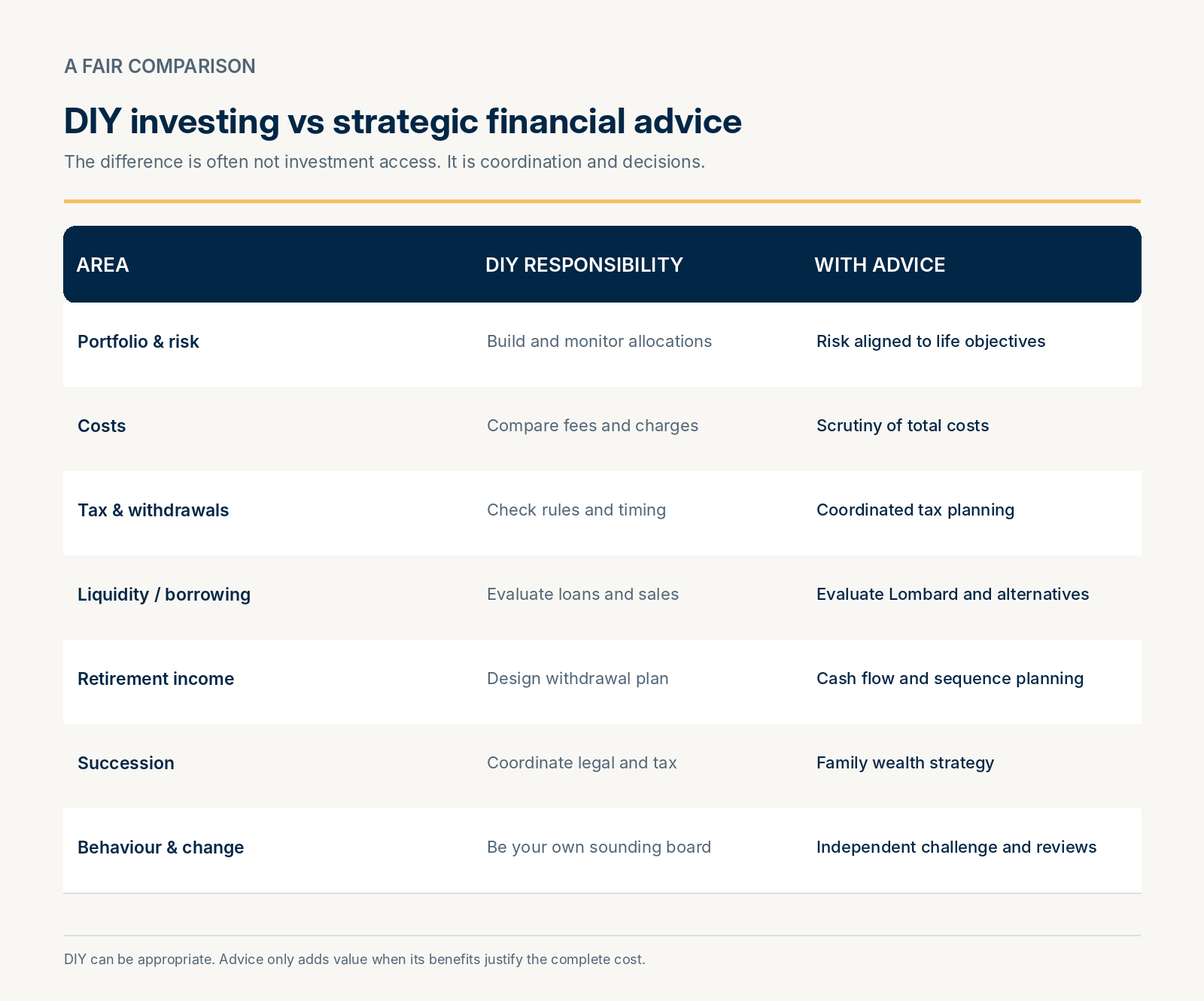
There has never been more information, research or low-cost investment technology available to individual investors. With sufficient knowledge and discipline, many people can build diversified portfolios, use tax allowances and manage their affairs effectively themselves.
That should be acknowledged, not dismissed.
The key distinction is often that DIY means you are responsible for recognising, analysing and implementing every important decision yourself. That includes knowing when the issue has moved beyond portfolio management into borrowing and liquidity, tax law, retirement sustainability, family succession or cross-border planning.
A good adviser provides another set of experienced eyes, asks questions you might not have considered, helps quantify trade-offs, coordinates specialist advice and follows through on agreed actions.
But advice is not automatically better. Poor advice, high costs, unsuitable products, unnecessary transactions or a service that amounts to little more than an annual portfolio report may leave a client worse off.
For straightforward circumstances, a targeted piece of one-off advice may be sufficient. For complex wealth, ongoing strategic oversight can be more valuable because the difficult decisions rarely arrive all at once.
The 3am Test: The Value That Does Not Fit in a Spreadsheet
There is another way I think about this.
Imagine someone who has spent thirty years working hard, building a business, making sensible investments and accumulating considerable wealth. On paper, they are financially successful.
Yet they still wake at three in the morning wondering whether retirement will be secure, whether the next market fall will damage their plans, whether they can help their children, or whether their family will face avoidable complications when they die.
They may not need more money. They may need a clearer understanding of what the money they already have can safely do for them.
A well-considered financial strategy cannot remove uncertainty from life, and no adviser should suggest otherwise. But it can replace vague fears with informed decisions, reasonable contingency plans, clear responsibilities and someone to contact when circumstances change.
That is not just an emotional benefit. It can mean retiring when you want to, taking a holiday without guilt, helping a family member at the right moment, or simply spending less time worrying about matters you do not need to manage alone.
The ideal outcome is not necessarily a bigger number on the next statement. Sometimes it is a better night’s sleep.
So How Should an Adviser Demonstrate Value Against Fees?
I think a financial adviser should be able to explain, in plain language, what the client is receiving and why the work matters.
Useful questions include:
- Are the total costs — adviser, platform, fund and product charges — transparent and justified?
- Is the investment allocation appropriate for the client’s objectives and capacity for loss?
- Have realistic retirement-income and cash-flow scenarios been modelled and reviewed?
- Are the available tax allowances, wrappers and withdrawal options being used intelligently?
- Have major liquidity and borrowing decisions, including any potential use of Lombard lending, been tested against the risks and realistic alternatives?
- Have meaningful inheritance and succession risks been identified, with specialist input where appropriate?
- Does the client know what has been implemented, what still needs attention and who is responsible?
- Does the advice help the client make more confident decisions about life, not only investments?
Some of this value can be recorded in pounds. Some is better measured through improved resilience, clearer choices, time saved and greater confidence. And it is entirely legitimate for a client to ask whether an ongoing service still justifies its ongoing charge.
My Approach: Strategic Financial Planning Rather Than Isolated Transactions
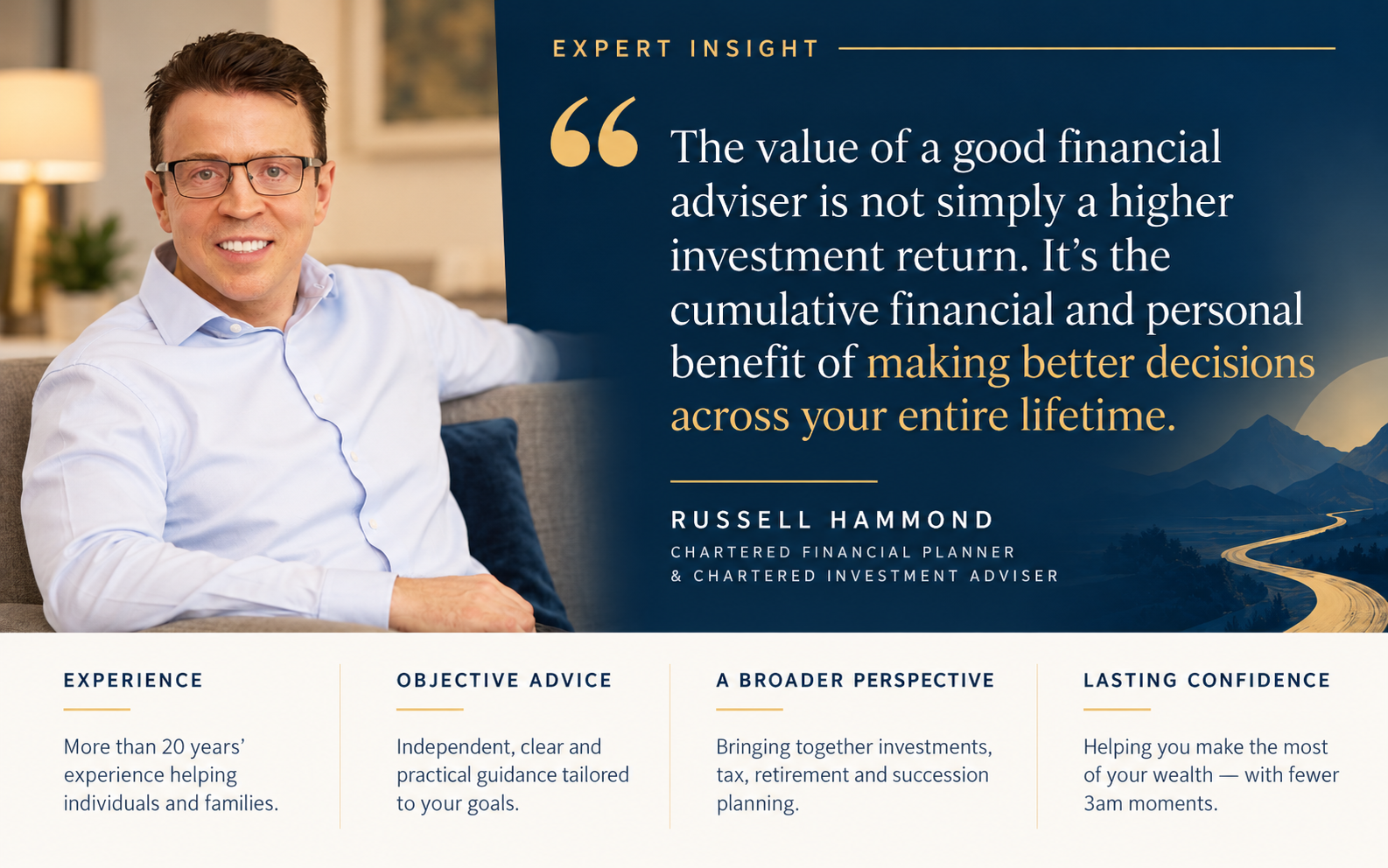
As a Chartered Financial Planner and Chartered Investment Adviser with more than 20 years’ experience, my aim is to help clients bring their financial arrangements together into a coherent strategy.
That includes evidence-based investments, cash-flow modelling, retirement income, tax-efficient structuring, appropriate consideration of Lombard lending, family succession and coordination with solicitors, accountants and specialist tax professionals where necessary.
I have written separately about this in Beyond Investment Management: Why Your Wealth Needs a Coordinated Financial Strategy.
Not every client needs every service or every structure. In fact, a useful piece of advice can sometimes be not to make an unnecessary change.
What matters is having a clear understanding of where you are, what you want your wealth to achieve and how your financial decisions fit together.
Final Thought: The Value of Advice Should Be Measured in Lives, Not Just Basis Points
The evidence suggests that thoughtful financial advice can create substantial value. But no credible adviser should claim a universal percentage uplift or guarantee that advice will pay for itself for every client.
Investment management remains important. So do fees. Yet a lifetime of financial outcomes is also shaped by taxes, borrowing, behaviour, retirement timing, withdrawal decisions, family circumstances and the ability to enjoy what you have accumulated.
The real test of good financial advice is not whether it makes you richer than an index. It is whether it helps you use your wealth more intelligently, avoid costly mistakes and live with greater confidence.
That is the standard I believe advisers should be prepared to meet.
Discuss Your Financial Strategy
If you have substantial investments, complex pension arrangements, important retirement decisions or family succession questions, I would be pleased to help you examine the bigger picture.
An initial conversation is an opportunity to explore your objectives, understand your existing arrangements and consider whether strategic financial planning could make a meaningful difference to you.
Get in touch to discuss your financial planning.
Important information: This article is for general information and does not constitute personal investment, financial, tax or legal advice. The worked examples are hypothetical, ignore certain costs and taxes where stated, and do not demonstrate actual or guaranteed client outcomes. Lombard lending creates debt secured on investments and may result in margin calls or forced sales; interest rates and investment values can change, and borrowing may magnify losses. Investments can fall as well as rise in value. Tax treatment depends on personal circumstances and may change. Specialist legal or tax advice may be required.
Frequently Asked Questions
Is a financial adviser worth paying 1% a year on £4 million?
A 1% adviser charge on £4 million is £40,000 a year before platform and fund charges. That is a meaningful cost. It is worthwhile only if the service is appropriate and the value it adds — for example through coordinated tax planning, retirement decisions, appropriate investments, succession or avoiding mistakes — justifies that cost compared with credible alternatives. Advice should be assessed regularly rather than assumed to be beneficial.
Can a financial adviser really add 3% in investment returns?
Vanguard's Adviser's Alpha analysis discusses potential additional net investment returns through a range of advisory practices, including behavioural coaching and tax-efficient planning. It does not mean every adviser can deliver a guaranteed 3% a year. Results differ according to personal circumstances, starting arrangements, investment costs and the advice delivered. It is better to assess actual advice outcomes than assume a universal return uplift.
Can Lombard lending help a wealthy investor avoid capital gains tax?
A Lombard loan can provide cash against eligible investments without selling them. Because borrowing itself is not a disposal of the pledged investments, it may prevent an immediate capital gains tax liability that would otherwise arise from selling personally held investments outside a tax shelter. It does not remove unrealised gains or guarantee a permanent tax saving. The loan carries interest, collateral and margin-call risks. A repayment strategy and individual tax advice are important.
Is DIY investing better than professional advice?
DIY investing may be an excellent choice when someone's finances are simple and they have the time, knowledge and discipline to run a diversified, low-cost portfolio. Advice becomes more relevant where retirement sustainability, tax-efficient withdrawals, succession, borrowing and family arrangements need to be coordinated. A one-off project may be sufficient for some; others may benefit from ongoing oversight. The costs and services should always be compared transparently.
What is the greatest benefit of strategic financial planning?
The greatest benefit depends on the family. It could be the financial value of reducing unnecessary costs, making more effective withdrawal choices, structuring gifting, or analysing whether Lombard borrowing is appropriate. It can also be the confidence to retire, spend or help family members without undue worry. The best financial plan helps someone use wealth intelligently for their life objectives, rather than simply aiming to maximise portfolio value.