What Wednesday’s Budget Means for a £5 Million Portfolio

Key takeaways
- Asset mix matters. A £5m household balance sheet can include a home, restricted pensions and investments with different tax treatments.
- Separate new changes from earlier announcements. The example isolates Wednesday’s additional rise from the rise already due in April 2027.
- Income tax and CGT are different calculations. Rental profit, interest, dividends and realised gains need separate attention.
- Tax deferral needs an exit plan. An offshore bond’s future chargeable-event tax and charges still matter.
- Review the whole family plan. Cash flow, pension death benefits, ownership and access should guide decisions.

A £5 million balance sheet can look reassuring. But a family home, a rental property, a pension and an offshore bond do very different jobs—and face different tax rules.
Following the Budget on Wednesday 28 October 2026, the useful question is: what changes for the money you spend, the investments you hold and the wealth you hope to pass on?
Here is a fictional married couple living in England, with a mixture of property and financial assets. The example separates Wednesday’s announcements from changes already on the way.
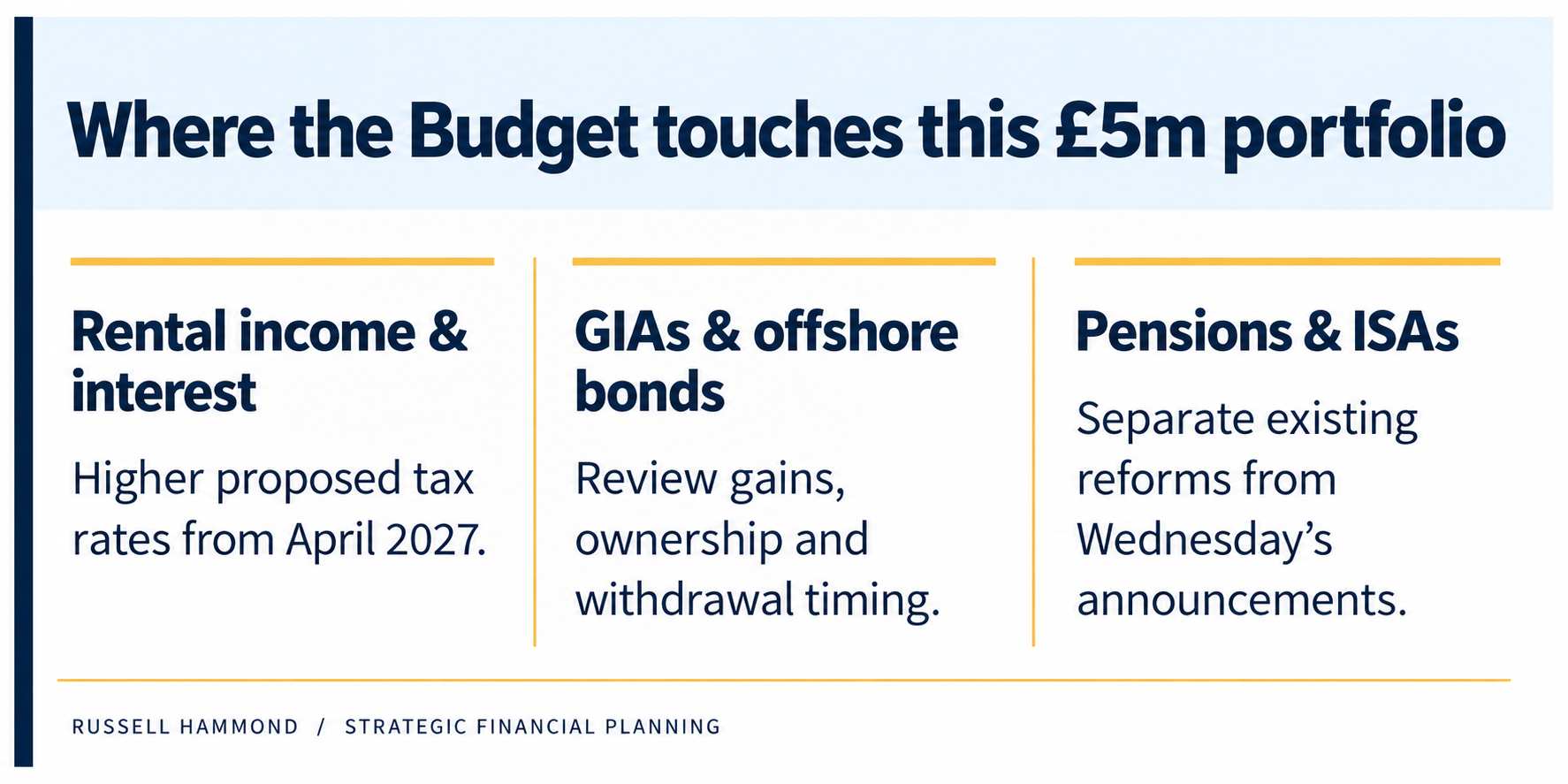
Meet the £5 million household
| Asset | Illustrative value | What it contributes |
|---|---|---|
| South East family home | £1,000,000 | A place to live; no rental income |
| Mortgage-free English rental property | £750,000 | £30,000 annual taxable rental profit |
| Defined contribution pensions | £1,250,000 | Future retirement income; no withdrawals modelled |
| Offshore investment bond | £800,000 | Longer-term investment; no chargeable event modelled |
| General investment accounts (GIAs) | £700,000 | £14,000 dividends and £7,000 interest a year |
| ISAs | £350,000 | Investments sheltered from UK income tax and CGT |
| Cash outside ISAs | £150,000 | £6,000 annual interest |
| Total household wealth | £5,000,000 | Includes the home and assets with access restrictions |
These are assumed values and income figures, not forecasts. The couple are long-term UK residents, with no debt. Taxable rent, interest and dividends are owned equally. Both have used their personal allowances against other income, and all the income illustrated remains within their higher-rate bands. Their £5 million is not £5 million of readily spendable investments.
The new pressure is on rental profit and savings income
HMRC’s Budget policy paper proposes savings and property rates of 24%, 44% and 49% from 6 April 2027. Savings rates apply across the UK; the announced property rates apply in England, Wales and Northern Ireland, subject to devolved powers.
For our higher-rate couple, the rental profit and interest above their available savings allowances would therefore face 44%. Today, the corresponding rate is 40%.
But that four-percentage-point difference is not all new. A rise to 42% had already been announced for April 2027. Wednesday added a further two percentage points, as the Budget speech makes clear.
Our couple have £30,000 rental profit and £13,000 interest. After two £500 personal savings allowances, £42,000 is exposed to that rate change. Wednesday’s additional two points therefore mean £840 more annual tax. Compared with current rates, the combined rise is £1,680.
Try the Budget impact calculator
Adjust the household’s rent, interest, dividends and ownership below. The calculation includes unchanged dividend tax to give context, while isolating the additional savings and rental tax announced on Wednesday.
Your Budget income-tax impact
A focused illustration for a higher-rate household. Start with the article’s £5m portfolio, then change the income assumptions.
Enter a valid amount from £0 to £1,000,000 in each income field.
extra a year from Wednesday’s announcement.
total rise versus current rates, including the earlier announced rise.
Assumptions and limits
Rental and savings rates: 40% currently, 42% previously announced for April 2027, and 44% proposed after the 28 October 2026 Budget. Dividend rate remains 35.75%. Each owner’s personal allowance is already used, and all illustrated taxable income is assumed to remain within their higher-rate band. No band calculation is performed: large inputs can fall outside that assumption.
Equal beneficial ownership is assumed for each income stream. Unused allowances cannot be transferred between owners. Accumulation funds may still generate taxable distributions. Excludes capital gains, bond chargeable-event gains, pensions, personal allowance taper, additional-rate tax, starting-rate savings relief, mortgage finance-cost relief, losses, fees, overseas taxes and inheritance tax. Asset values do not directly determine income tax. No growth or return forecast; no investment recommendation.
Budget proposals may change before legislation. This focused illustration is not a personal tax computation. Sources: HMRC savings and property rates and rates and allowances. Checked 30 October 2026.
At the default settings, annual tax on these three income streams rises from £21,447.50 currently to £23,127.50 under the proposed April 2027 rates. Before Wednesday’s further increase, the equivalent April 2027 figure was £22,287.50. This is a focused illustration, not the couple’s complete tax return.
The GIA still needs its own capital gains plan
The ordinary CGT rates remain 18% and 24%, with an individual annual exemption of £3,000 in the published rates and allowances. Dividend rates are also unchanged by this Budget.
Suppose the couple realise £40,000 of ordinary investment gains, split equally, with both £3,000 exemptions unused and no losses. At 24%, the CGT would be £8,160. That is separate from the income-tax calculator and is not a new Budget charge.
The practical review is about the investments’ tax costs, available losses, the timing of disposals and genuine beneficial ownership. Moving assets between spouses can be relevant, but does not wipe out an existing gain. Selling purely to use an allowance can also incur costs and alter investment exposure.
The offshore bond needs a withdrawal plan
The £800,000 offshore bond is not producing taxable personal income in this illustration because we assume no chargeable event. That does not make it permanently tax-free.
HMRC’s foreign life-policy guidance explains that chargeable-event gains are subject to income tax, rather than CGT. The familiar cumulative 5% withdrawal facility normally defers tax; it is not a tax exemption. Most offshore policies do not carry the basic-rate tax credit associated with UK policies.
Higher future savings rates make the eventual tax position worth reviewing. Policy history, withdrawal method, ownership, other income and any top-slicing relief can change the outcome. This Budget also includes consequential changes affecting life-policy tax reporting. A bond surrender should follow a policy-specific calculation, rather than a reaction to a headline.
If an existing policy has become disconnected from your plans, an offshore bond review is a sensible starting point.

ISAs remain useful—and pensions need a separate family review
The Budget retains the £20,000 annual cash ISA limit from April 2027. That sits within the overall ISA subscription limit: it is not an extra £20,000 on top. For eligible adults with unused capacity, using both spouses’ allowances can gradually move future returns into a tax shelter. Our couple’s existing £350,000 ISA holdings do not create a fresh subscription allowance.
The £1.25 million pension holding deserves attention for a different reason. Under reforms already enacted, most unused pension funds and death benefits enter the inheritance-tax estate for deaths from 6 April 2027. This was not first announced on Wednesday.
For scale, £1.25 million multiplied by a 40% marginal inheritance-tax rate is £500,000. That is a sensitivity illustration, not this family’s tax bill: exemptions, beneficiaries, estate composition, available bands, charitable gifts and other reliefs need reviewing. The treatment of death benefits can also involve income tax. Wednesday’s technical pension changes do not amount to a general reversal of the inheritance-tax reform.
What I would review before changing the portfolio
Start with the family’s spending plan. Which assets will provide income, which can stay invested, and how much cash is needed for tax and unexpected costs? A valuable home cannot automatically fund retirement, and a rental property cannot be sold a little at a time.
Then compare the costs and consequences of possible changes. Moving taxable investments into an ISA may require a disposal. Selling the rental could trigger CGT and transaction costs. Adding money to a bond brings future income-tax considerations and charges. Borrowing against investments adds interest and collateral risk.
For some families, gifting, pension contributions or specialist investments may have a place. None should be selected simply because the tax relief sounds attractive. The first test is whether the decision supports the family’s access needs, investment risk and longer-term goals.
That is the value of Strategic Financial Planning: bringing property, pensions, investments, cash flow and family priorities into one coordinated plan. With more than 20 years’ experience, I help clients turn these separate questions into decisions they can act on with confidence.

Information checked on 30 October 2026. Budget proposals remain subject to legislation and may change. This article is general information, not personalised financial, tax or legal advice. Tax treatment depends on individual circumstances. Investments can fall in value and you may get back less than you invest. Examples exclude fees, inflation and changes in market values.
Frequently Asked Questions
How does Wednesday’s Budget affect a £5 million portfolio?
It depends on the assets, ownership and income. In the article’s fictional higher-rate couple example, Wednesday’s further two-percentage-point increase adds £840 a year to tax on £30,000 rental profit and £13,000 interest after two £500 savings allowances. The comparison with current rates is £1,680 because an earlier rise was already announced.
Does the calculator work out my complete tax bill?
No. It illustrates tax on rental profit, interest and dividends for one or two equal higher-rate owners. Personal allowances are assumed used, income is assumed to remain within the higher-rate band, and individual £500 savings and dividend allowances are assumed available. It excludes CGT, bond gains, pension withdrawals, inheritance tax and other adjustments.
Did the Budget increase ordinary capital gains tax rates?
The published rates table retains ordinary CGT rates of 18% and 24%, and the £3,000 individual annual exemption. Other specialist reliefs and anti-avoidance measures can differ. A sale still needs its own gain calculation, ownership check and review of available losses.
Does holding an offshore bond mean the investment is tax-free?
No. An offshore bond may defer personal taxation until a chargeable event. Chargeable-event gains are generally taxed as income rather than capital gains, and withdrawals within the cumulative 5% facility are normally tax-deferred rather than tax-free. Policy history, charges and the method of withdrawal matter.
Was inheritance tax on unused pensions first announced this Wednesday?
No. Most unused pension funds and pension death benefits are due to enter the inheritance-tax estate for deaths from 6 April 2027 under earlier reforms. Wednesday’s technical changes should not be confused with a general reversal. The actual effect depends on exemptions, beneficiaries and the wider estate.
Continue reading
How Can I Reduce the Tax on My Investments?
Explore tax planning for a £2 million portfolio, from ISAs and spousal ownership to offshore bonds, Lombard lending and specialist investments. Includes an interactive calculator.
Offshore Investment Bonds: How They Can Strengthen Your Family’s Wealth Planning
Offshore Bonds Are Back in the Spotlight A recent Financial Times article highlighted a surge in the use of offshore investment bonds — and for good reason. UK residents [...]
Sold My Business: Financial Advice to Secure the Proceeds
Turning Business Proceeds Into Long-Term Financial Security If you’ve just sold your business, financial advice is no longer optional—it’s essential. The right planning at this stage can help you [...]