
Could You Run Britain Better?
Everyone has an opinion about how Britain’s finances should be managed.
Now it’s your turn.
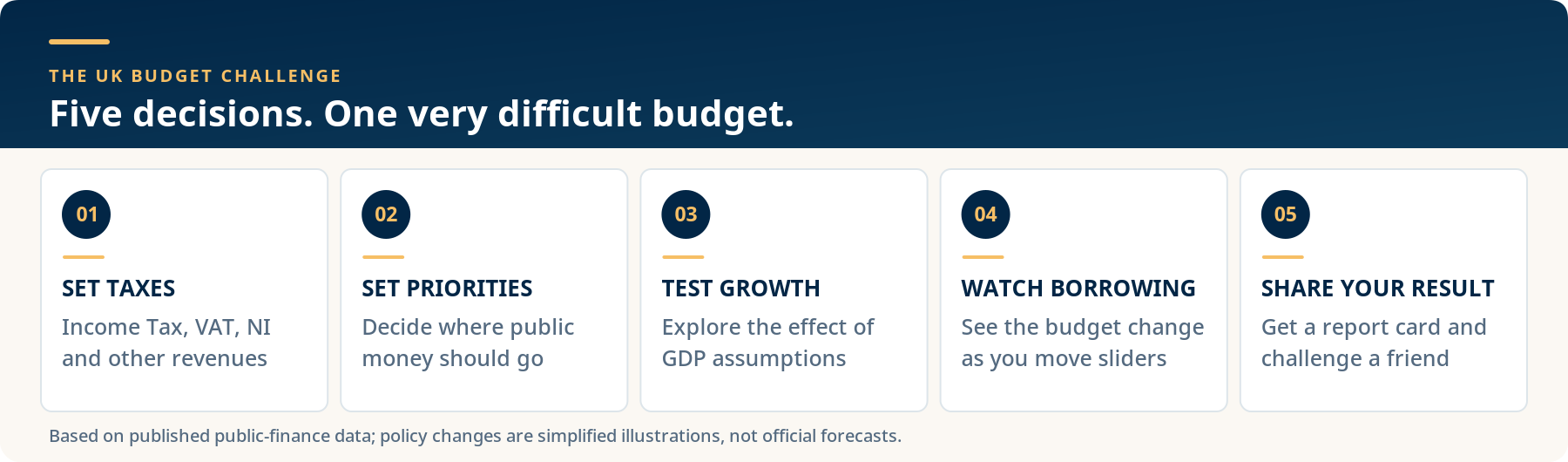
Take control of taxes, public spending and economic growth assumptions, and see whether you can balance Britain’s books without provoking a full Treasury meltdown.
Adjust the sliders, watch the numbers change and discover what your rather outspoken Treasury adviser thinks of your decisions.
When you’re finished, generate your Chancellor’s Report Card and challenge someone else to do better.
Congratulations. You're the Chancellor.
You've inherited a £115.5bn annual borrowing requirement. The NHS wants more money. Defence wants more money. Nobody wants higher taxes. How hard can it be?
Pull the levers
Adjust policy choices. The model updates immediately. All amounts are annual.
Income tax & personal taxation
Business, consumption & other taxes
Health, welfare & education spending
Defence, infrastructure & other spending
Big ideas & dangerous optimism
The Fiscal Juggler
Sources: OBR March 2026 forecast · House of Commons Library public spending briefing · HMRC ready reckoners. Baseline reviewed October 2026. Refreshed Budget figures required after the 28 October 2026 Budget.
A Bit of Fun. A Serious Point.
Britain’s public finances involve enormous sums of money, competing priorities and some rather uncomfortable trade-offs.
This simulator starts with published UK public-finance figures. The effects of changing taxes, spending and growth assumptions are simplified illustrations rather than official forecasts.
Real-world outcomes depend on economic conditions, taxpayer behaviour and countless other factors.
But that’s rather the point.
Balancing the books is easy when you’re shouting at the television. It’s a little harder when you’re holding the red Budget box.
Created by Russell Hammond
Chartered Financial Planner & Chartered Investment Adviser
I created the UK Budget Challenge as an entertaining way to explore the difficult financial decisions involved in managing Britain’s public finances.
When I’m not attempting to balance the country’s budget, I help individuals and families make better decisions about their own finances, investments and long-term plans.
You can learn more about my approach to Strategic Financial Planning.