UK Pension Transfers for Expats: Should You Keep Your Pension in the UK or Move It Overseas?

Key takeaways
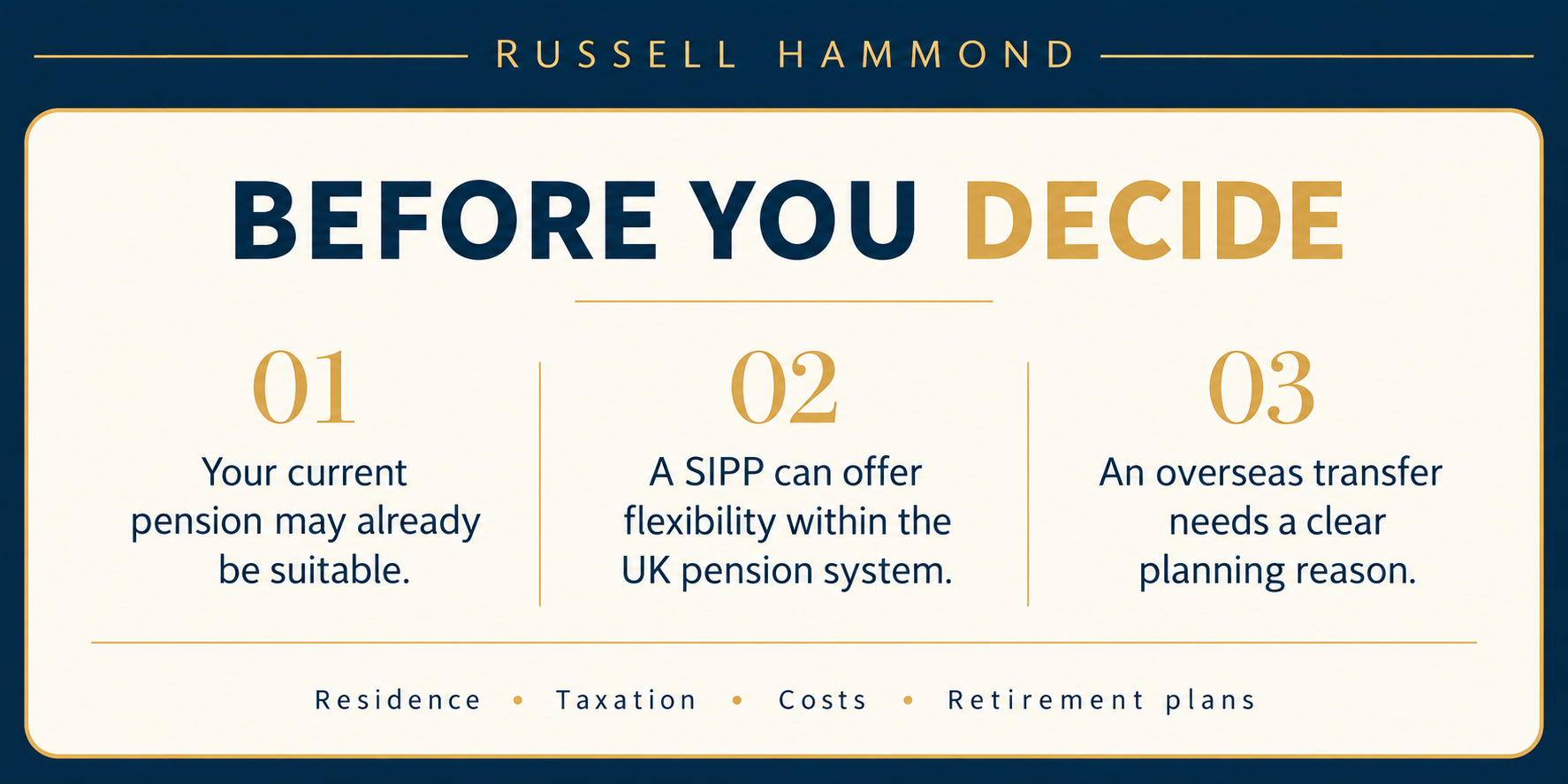
- Living overseas does not require a transfer. Your UK pension may remain appropriate.
- A UK SIPP may offer flexibility. An overseas transfer is not always necessary.
- QROPS transfers can trigger a 25% charge. Check the relevant exemptions and allowances.
- Defined benefit transfers require particular care. Valuable guaranteed benefits may be lost.
- Plan around your circumstances. Residence, taxation, costs, currency and retirement objectives all matter.

Living overseas does not necessarily mean that your UK pension should move with you. For British expatriates, deciding what to do with accumulated UK pension benefits can be one of the most important retirement planning decisions they make. Whether you are living in Europe, the Middle East, Asia or elsewhere, the right arrangement should reflect far more than your current country of residence.
The central question is not simply where your pension is held, but how effectively it supports your long-term retirement objectives. In many cases, retaining a UK pension or transferring into a Self-Invested Personal Pension (SIPP) can be appropriate. In others, a Qualifying Recognised Overseas Pension Scheme (QROPS) may warrant consideration. Taxation, investment flexibility, regulation, costs, currency exposure and future residency all matter.
What Happens to Your UK Pension When You Move Abroad?
Your UK pension does not automatically need to be transferred when you become non-UK resident. Most UK pension arrangements can remain in place while you live overseas, although providers may restrict contributions, investment changes, account servicing or withdrawals for non-UK residents.
Your pension will ordinarily retain its UK tax-advantaged structure, but the treatment of withdrawals depends on your country of residence, the relevant double taxation agreement and the benefits received. For expatriates anticipating a return to the UK, keeping an existing UK pension can be particularly attractive.
Your Three Main UK Pension Transfer Options
1. Leave Your Existing UK Pension Where It Is
Sometimes doing nothing is the most appropriate decision. An existing scheme may offer competitive charges, suitable investments and the benefits you need. Before making changes, investigate valuable guarantees, protected tax-free cash and other safeguarded benefits. These can be difficult or impossible to replace.
2. Transfer Your UK Pension to a SIPP
A Self-Invested Personal Pension is a UK tax-advantaged pension structure that can offer broader investment choice, diversified portfolios and flexible retirement withdrawals. Consolidation of historic UK pensions may simplify administration and improve oversight.
Living abroad does not automatically prevent you from maintaining or transferring to a UK SIPP. The receiving provider must be willing and permitted to accept your business, however, and local advice or distribution restrictions may apply. A SIPP remains subject to UK pension legislation.
3. Transfer Your UK Pension to a QROPS
A Qualifying Recognised Overseas Pension Scheme is an overseas pension arrangement meeting conditions set by HMRC. Depending on the scheme and jurisdiction, it may offer different investment options, currency features or arrangements relevant to long-term overseas retirement.
However, QROPS should not automatically be regarded as more tax-efficient than a UK SIPP. Transfer charges, overseas regulation, establishment fees, ongoing costs and restrictions on benefits can materially affect the outcome.
Understanding the 25% Overseas Transfer Charge
A transfer to a QROPS is generally subject to a 25% Overseas Transfer Charge unless a qualifying exemption applies. Separate rules also apply to transfers above the applicable overseas transfer allowance.
Since 30 October 2024, the former general exemption for transfers to QROPS in the European Economic Area and Gibraltar has been removed. An exemption may still apply where an individual is resident in the same country as the receiving QROPS, subject to the relevant statutory conditions. Certain qualifying occupational arrangements also have exemptions.
A British expatriate resident in one country who transfers a UK pension to a QROPS in another country could therefore incur a substantial immediate charge. On a £500,000 pension, a charge of 25% would amount to £125,000 if the entire transfer were chargeable.
Reference: HMRC — Overseas Transfer Charge changes.
SIPP vs QROPS: Which Is Better for British Expats?
There is no universal answer. A UK SIPP may suit an expatriate who values UK pension regulation, flexible investment options, transparent costs and continuity with UK benefits. A QROPS may warrant consideration where permanent overseas residence creates identifiable regulatory, tax or retirement-planning advantages.
- Where do you live now, and where do you intend to retire?
- Does the existing pension have safeguarded benefits?
- How do initial and ongoing costs compare?
- How would withdrawals be taxed where you live?
- What investment, currency and beneficiary options are available?
- What happens if you return to the UK?
A pension structure that looks attractive today may become less suitable if your country of residence changes.
How Are UK Pension Withdrawals Taxed When Living Abroad?
UK pension income may initially be subject to UK PAYE withholding even where a double taxation agreement ultimately allocates taxing rights to another country. Depending on the treaty, it may be possible to obtain relief from UK taxation or reclaim tax deducted.
The treatment of pension income, lump sums and death benefits can differ between jurisdictions. A withdrawal treated as tax-free under UK rules is not necessarily exempt in the country where you live. Moving a pension overseas does not automatically eliminate UK tax obligations.
What About Final Salary and Defined Benefit Pensions?
Defined benefit schemes ordinarily promise a retirement income linked to salary and service. Transferring to a SIPP or QROPS can mean surrendering guaranteed benefits and accepting investment and longevity risks.
Where safeguarded pension benefits exceed £30,000, appropriate regulated transfer advice is generally mandatory before a transfer to a defined contribution arrangement. The FCA’s starting presumption is that retaining defined benefit benefits will suit most members.
Reference: FCA — Defined Benefit Pension Transfers.
Why Currency Matters — But Shouldn’t Dictate the Decision
The currency in which your pension is administered is not necessarily the same as the currency exposure of its underlying investments. A UK SIPP may accommodate internationally diversified investments or multiple currencies, depending on the provider. A QROPS does not automatically eliminate currency risk.
The relevant objective is aligning investments and future withdrawal arrangements with your expected retirement spending rather than transferring solely because the pension is based in the UK.
The Importance of Pension Transfer Costs
Compare the total cost of ownership: pension administration, investment management, financial advice, custody, currency conversion and any establishment or contractual charges. Modest annual differences compound over a long retirement, although low fees alone do not make an unsuitable arrangement appropriate.
Should You Transfer Your UK Pension Before Returning to Britain?
A possible return to the UK should be part of the original decision. Future tax residence, withdrawal plans and wider investment arrangements may make retaining a UK pension simpler. If benefits have already moved to a QROPS, transfer back to a UK arrangement may be possible, subject to scheme rules.
For further information, explore my Returning to the UK Toolkit and guide to transferring a QROPS back to the UK.

My Approach to UK Pension Transfers for Expats
Having worked with internationally mobile clients for more than 20 years, I regard pension transfers as part of a much broader financial planning exercise. Rather than beginning with a particular product, I believe the starting point should be your objectives, existing assets, future income needs and likely country of retirement.
From there, we can evaluate whether retaining an existing arrangement, consolidating into a UK SIPP or considering an overseas scheme is appropriate. The goal is not simply to transfer a pension: it is to structure retirement capital to support long-term financial security.
Discuss Your UK Pension Transfer Options
If you live overseas and would like to review your UK pensions, I would be delighted to discuss your circumstances. As a Chartered Financial Planner and Chartered Investment Adviser, I help clients assess retirement arrangements within a coordinated approach to Strategic Financial Planning.
This article provides general information rather than a personal recommendation. Pension transfer suitability, taxation and regulatory protections depend on individual circumstances and the relevant jurisdictions.
Frequently Asked Questions
Can I transfer my UK pension if I live abroad?
Yes, in many cases. Provider acceptance, local regulatory restrictions and your existing pension benefits must all be considered.
Is a SIPP better than a QROPS for expats?
Neither is automatically better. The right arrangement depends on residence, tax treatment, costs, benefits and retirement objectives.
Will I pay 25% tax when transferring my UK pension overseas?
A transfer to a QROPS is generally subject to the 25% Overseas Transfer Charge unless a qualifying exemption applies. The overseas transfer allowance is a separate consideration.
Can I leave my UK pension in Britain when I retire abroad?
Yes. Many expatriates retain UK pensions and draw benefits overseas. Provider restrictions, currency considerations and local tax treatment should be reviewed.
Can I transfer a final salary pension to a QROPS?
Some defined benefit pensions may be transferable, but restrictions and safeguards apply. For safeguarded benefits exceeding £30,000, appropriate regulated transfer advice is generally required, and giving up guarantees is unsuitable for most members.
Continue reading
Moving Back to the UK with a QROPS? Your Complete Guide
Returning to the UK after living overseas can raise a number of important financial planning questions, particularly if you hold pension benefits within a Qualifying Recognised Overseas Pension Scheme [...]
Transfer a Gibraltar QROPS to a UK SIPP: Rules, Tax and Drawdown
If you have a pension held in a Gibraltar Qualifying Recognised Overseas Pension Scheme (QROPS), you may be surprised to discover that the rules governing withdrawals are quite different [...]
Financial Advice for British Expats in Oman: Pension Planning, Investment Strategy & IHT Mitigation
How to Protect and Grow Your Wealth While Living in Oman For British expats living in Oman, the combination of tax-free income, a relaxed lifestyle, and strong earning potential [...]