Offshore Bond Withdrawal Advice: How to Avoid Unnecessary Tax

Key takeaways
Key Takeaways
- Offshore bond withdrawals are generally governed by income tax rules rather than capital gains tax.
- The 5% annual withdrawal allowance is tax-deferred, not tax-free, and unused allowances can ordinarily be carried forward.
- Surrendering individual policy segments can produce a substantially different tax outcome from making a partial withdrawal across the entire bond.
- Assigning policy segments to family members can offer valuable income tax and inheritance tax planning opportunities.
- Top-slicing relief, withdrawal timing and periods of non-UK residence can materially influence the eventual tax liability.
- Effective offshore bond management involves ongoing decisions about retirement income, investment strategy, taxation and family wealth planning.
Many investors spend considerable time considering which offshore bond to establish, which investment funds to select and which provider to use. Far less attention is sometimes given to an equally important question: what happens when you eventually want to withdraw your money?
This can be particularly important for investors who have held offshore bonds for many years, accumulated substantial investment gains or returned to the UK after living overseas.
Unlike an ordinary investment account, where selling investments will generally create a capital gains tax consideration, offshore investment bonds operate under a separate set of income tax rules.
The way you access your investment can therefore make a considerable difference to the tax you pay.
A partial withdrawal, surrender of individual policy segments and assignment to a family member can each produce very different outcomes, even when the underlying investment value is identical.
In my experience, this is an area where investors frequently need more advice than they originally received when establishing their policies.
It’s also one of the reasons why ongoing financial planning is so important when managing an offshore investment bond. The decisions you make about withdrawals need to be considered alongside your income requirements, investments, family circumstances and long-term financial objectives.
How Are Offshore Bond Withdrawals Taxed in the UK?
Offshore investment bonds are generally structured as life assurance policies or capital redemption contracts.
Although the investments held within the bond may include funds, equities and other assets, the UK taxation of withdrawals is governed by the chargeable event regime.
This means that gains arising on certain withdrawals, assignments for consideration, maturities or full surrenders are generally subject to income tax rather than capital gains tax.
There is another important distinction between offshore and UK investment bonds.
With most UK investment bonds, policyholders are treated as having paid basic-rate income tax on chargeable event gains. This is generally not the case with offshore investment bonds, meaning the UK income tax liability on an offshore bond gain can be more substantial.
The amount of tax payable depends on several factors, including your other income, how the withdrawal is structured, the bond’s history and any applicable reliefs.
For this reason, it is important to establish the likely chargeable event gain before requesting a substantial withdrawal.
The 5% Offshore Bond Withdrawal Allowance Explained
One of the most familiar features of an offshore investment bond is the ability to withdraw up to 5% of the original investment each policy year without an immediate income tax charge.
This is commonly described as the 5% withdrawal allowance.
However, the terminology can be misleading.
The 5% allowance is tax-deferred, not tax-free.
Withdrawals made within the available allowance will ordinarily be included in the calculation of the chargeable event gain when the relevant policy is eventually surrendered or otherwise brought to an end.
How Financial Adviser and Investment Management Fees Affect Your 5% Allowance
Another frequently overlooked consideration is how ongoing adviser and investment management fees are deducted from an offshore bond.
Where ongoing financial advice fees are paid directly from the bond, these are ordinarily treated as withdrawals and count towards the accumulated 5% tax-deferred allowance.
For example, an offshore bond established with a £1 million investment would initially generate an annual 5% allowance of £50,000. If £10,000 of ongoing financial advice fees is deducted from the bond during the policy year, this would ordinarily leave £40,000 of that year’s allowance available for other withdrawals, assuming no unused allowances from earlier years.
However, certain offshore bonds can accommodate investment management arrangements under which fees for managing the underlying investments are treated as expenses of the bond rather than withdrawals by the policyholder.
Where the investment management service is provided to the insurance company under an appropriate contractual arrangement, these fees may not reduce the available 5% withdrawal allowance.
The distinction is important: simply describing a financial advice fee as an investment management fee does not change its tax treatment.
The provider’s charging structure, contractual arrangements and services actually being delivered must all support the treatment.
As part of my ongoing financial planning and investment management service, I review how charges are structured and deducted, ensuring that their implications for the bond’s tax-deferred withdrawal allowance are properly understood.
How Does the 5% Allowance Work?
Suppose you invested £2,000,000 into an offshore bond.
Your annual 5% withdrawal allowance would initially be £100,000.
If you did not make any withdrawals during the first five policy years, you would ordinarily have accumulated a tax-deferred allowance of £500,000.
You could then withdraw that amount without immediately creating a chargeable event gain under the 5% rule, assuming there are no other relevant transactions affecting the calculation.
The allowance accumulates for a maximum of 20 policy years for each premium, equivalent to 100% of the amount invested.
Importantly, the allowance is calculated by reference to premiums paid, rather than the current investment value.
You can read more in HMRC’s explanation of the 5% tax-deferred withdrawal rule.
Why the 5% Allowance Isn’t Always the Best Option
For someone requiring regular income, the 5% withdrawal facility can be extremely useful.
It may allow withdrawals to be taken during periods of high income, with the resulting tax charge deferred until a time when the policyholder expects to have a lower marginal tax rate.
However, continually using the allowance without considering the eventual surrender can create problems.
Someone who has withdrawn significant amounts over many years may still face a substantial chargeable event gain when the bond is finally surrendered.
The key question isn’t simply how much can be withdrawn without an immediate tax charge.
It’s whether using the 5% allowance is the most appropriate approach when considering the entire lifetime of the investment.
This is precisely the type of decision that benefits from regular reviews of both the bond and the policyholder’s wider financial circumstances.
Partial Withdrawals vs Surrendering Individual Policy Segments
This is one of the most important, and frequently misunderstood, areas of offshore bond withdrawal planning.
Many offshore bonds are issued as a collection of individual policies, often called segments or sub-policies.
An investment of £2,000,000 might, for example, be divided into 100 individual policies, each representing an initial investment of £20,000.
Although these policies are typically managed together, they remain separate contracts for relevant tax purposes.
This creates two fundamentally different ways of accessing capital.
Option One: Partial Withdrawal Across the Bond
You can request a withdrawal that reduces the value of the individual policies while leaving them in force.
Where the withdrawal exceeds the available 5% allowance, a chargeable event gain may arise.
Crucially, the gain calculated under these rules may bear little relationship to the actual investment profit attributable to the money withdrawn.
In some circumstances, this produces a surprisingly large taxable gain.
Option Two: Full Surrender of Selected Policy Segments
Instead of taking a withdrawal proportionately across all segments, you may be able to surrender a selected number of individual policies in full.
The chargeable event gain is then calculated by reference to the surrendered policies, taking account of their premiums, benefits and relevant previous gains.
This can produce a materially different tax outcome.
Worked Example: Why the Withdrawal Method Matters
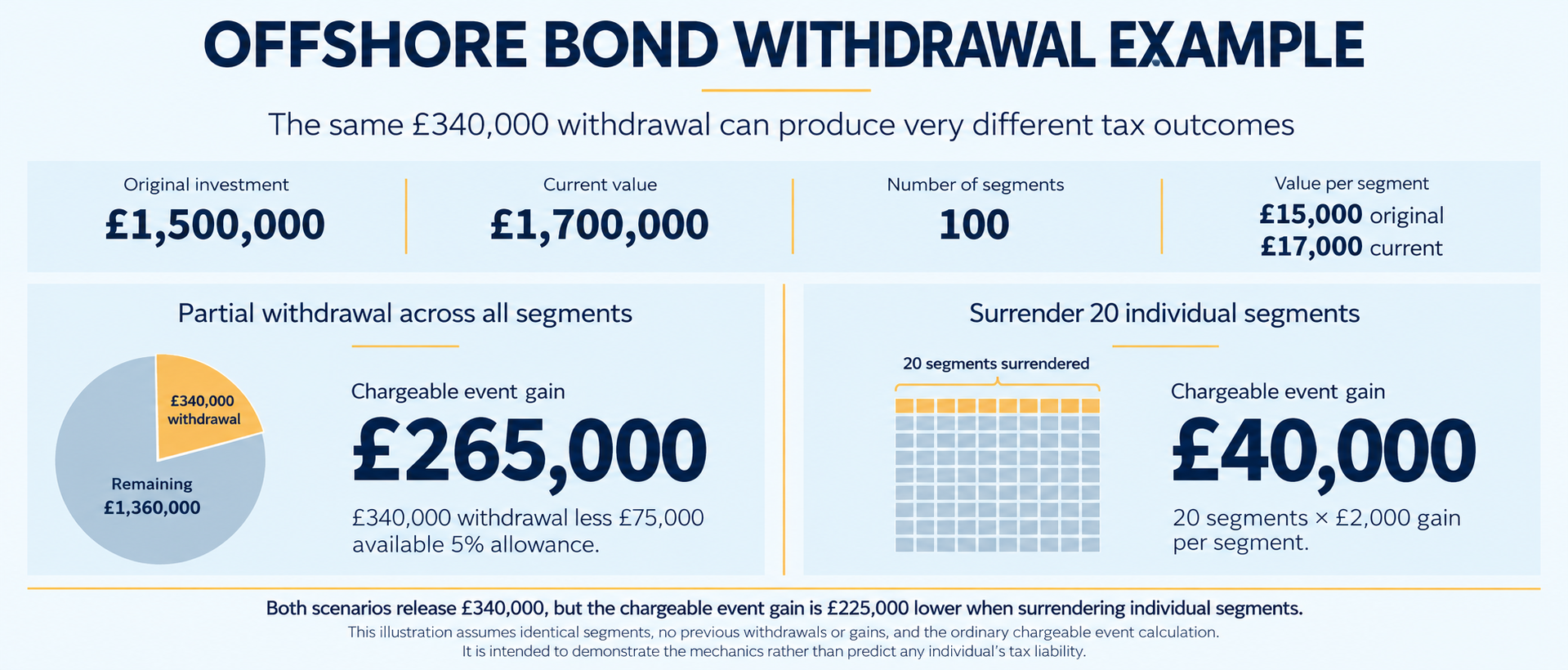
Consider an offshore bond with the following characteristics:
- Original investment: £1,500,000
- Current investment value: £1,700,000
- Number of identical policy segments: 100
- Original investment per segment: £15,000
- Current value per segment: £17,000
Assume the investor wants to withdraw £340,000 during the first policy year, with no previous withdrawals or chargeable event gains.
Approach A: Partial withdrawal across all 100 segments
The available 5% allowance is £75,000.
A partial withdrawal of £340,000 would therefore produce an excess of £265,000 under the normal 5% calculation.
This is the chargeable event gain, subject to the detailed rules.
Approach B: Surrender 20 individual segments
Each segment is worth £17,000 and originally cost £15,000.
The gain attributable to each surrendered segment is therefore £2,000.
Surrendering 20 segments produces:
- Capital released: £340,000
- Chargeable event gain: £40,000
- Remaining segments: 80
In this simplified example, the same £340,000 withdrawal produces very different chargeable event gains.
| Withdrawal method | Chargeable event gain |
|---|---|
| Partial withdrawal across all segments | £265,000 |
| Full surrender of 20 segments | £40,000 |
The difference is £225,000 in the gains assessed, before considering any applicable reliefs or the investor’s wider income tax position.
This does not necessarily mean that segment surrender will always produce the lowest lifetime tax liability. Partial withdrawals can defer taxation, while surrendering segments brings the relevant investment gains into charge immediately.
The appropriate approach depends on what the investor is trying to achieve.
This illustration assumes identical segments, no previous transactions or gains, and the ordinary chargeable event calculation. It is intended to demonstrate the mechanics rather than predict any individual’s tax liability.
Why the Withdrawal Method Matters
The example above illustrates why offshore bond withdrawal planning deserves careful consideration.
It’s not simply a question of how much you want to withdraw. The structure of your bond, its withdrawal history and your personal tax circumstances can all influence the most appropriate approach.
For investors holding substantial offshore bonds, comparing the available withdrawal methods before giving instructions to the provider can be particularly valuable.
Assigning Offshore Bond Segments to Family Members
One of the most valuable features of certain segmented offshore bonds is the ability to assign individual policies to other people.
This is particularly relevant for investors considering family gifting, retirement income planning or passing wealth to the next generation.
Under the UK chargeable event rules, an outright assignment of a policy by way of gift, without money or money’s worth being received in return, does not ordinarily trigger an immediate income tax chargeable event.
This means that an existing offshore bond may offer planning opportunities beyond simply surrendering policies and distributing the proceeds.
Assignment to a Spouse or Civil Partner
Suppose one spouse owns an offshore bond with a substantial accumulated investment gain.
The owner is an additional-rate taxpayer, while their spouse has considerably less taxable income.
Subject to the policy terms and the couple’s circumstances, it may be appropriate to assign individual segments outright to the lower-income spouse before surrender.
Because the recipient becomes the beneficial owner, the subsequent chargeable event gain may be assessable on them rather than the original owner.
The assignment must be genuine, and the implications of any subsequent withdrawals or transfers need to be considered.
Assignment to Adult Children
A similar opportunity can arise where parents or grandparents wish to provide financial support to adult children.
Rather than surrendering a substantial bond themselves, incurring the associated income tax liability and then gifting the proceeds, they may consider assigning individual policy segments to the intended recipients.
The recipients can subsequently decide whether to retain or surrender their policies.
Depending on their income and tax circumstances, this may produce a more favourable result than a surrender by the original owner.
This can be especially relevant when providing funds towards a house purchase, university costs or other significant family expenses.
However, transferring a policy can also have inheritance tax consequences, and the recipient’s wider tax position must be reviewed.
HMRC provides specific guidance on the tax treatment of offshore bond assignments.
Offshore Bond Assignments and Inheritance Tax Planning
Assignments can also form part of a wider inheritance tax strategy.
An outright gift of policy segments to an individual will commonly be a potentially exempt transfer for inheritance tax purposes, provided the relevant conditions are satisfied.
This means that the normal inheritance tax rules for lifetime gifts must be considered, including the donor’s survival period and any relevant exemptions.
Assignments into trusts can have different consequences, potentially including immediate inheritance tax charges and ongoing trust taxation.
It’s also important to distinguish the ownership of the bond from the lives assured under a life assurance policy. Transferring ownership does not necessarily change whose death will bring the policy to an end.
An assignment is not simply an administrative change. It can alter the beneficial ownership, income tax position and inheritance tax treatment of a substantial investment.
For that reason, I would generally want to consider the wider family circumstances before recommending one.
Full Surrender of an Offshore Bond: What Should You Consider?
Investors sometimes reach a point where they no longer need their offshore bond and want to surrender the entire investment.
This may follow retirement, a change in country of residence, a major purchase or a decision to simplify their financial arrangements.
However, full surrender can crystallise accumulated chargeable event gains in a single tax year.
For a longstanding offshore bond, particularly one with significant investment growth, the tax consequences can be substantial.
Before recommending full surrender, I would ordinarily consider several alternatives.
Spreading Surrenders Across Tax Years
Where an investor does not need all the proceeds immediately, it may be appropriate to surrender individual policy segments over more than one tax year.
This can help manage how much additional income falls into each year’s tax calculation.
Depending on the individual’s circumstances, spreading chargeable event gains may help avoid unnecessarily exposing substantial amounts to higher or additional income tax rates.
Timing Withdrawals Around Retirement
A client who is currently earning a substantial salary but expects to retire shortly may benefit from delaying some bond encashments.
Similarly, someone taking pension income, dividends or other substantial investment income may need to consider how these interact with chargeable event gains.
The available income tax bands, personal allowances and other relevant considerations can change significantly between tax years.
Reviewing Top-Slicing Relief
Top-slicing relief is an important consideration when a substantial chargeable event gain arises.
It is discussed in more detail below.
Considering Family Assignments
Where the intention is to distribute some of the proceeds to family members, it may be worth considering whether assigning segments before surrender is preferable to surrendering the bond personally and gifting cash afterwards.
This should always be considered alongside the genuine intention to transfer ownership and the wider inheritance tax implications.
Top-Slicing Relief: Reducing Tax on Offshore Bond Gains
One of the challenges with investment bonds is that gains may accumulate over many years but become taxable in a single tax year.
For example, someone could hold an offshore bond for 15 years, building up substantial investment growth, and then surrender it after retirement.
Without any relief, the resulting gain might move a significant amount of income into higher or additional rate tax bands.
Top-slicing relief is intended to mitigate some of this effect.
Broadly, the calculation considers the gain by reference to a specified number of complete policy years, potentially reducing the tax attributable to the chargeable event.
However, it is important to understand that top-slicing relief does not mean you simply divide the gain by the number of years and report that smaller amount as taxable income.
The full chargeable event gain remains relevant to the income tax calculation, while top-slicing relief is calculated separately.
The number of years used can also be affected by the type of chargeable event and periods of non-UK residence.
The interaction with personal allowances, other income and multiple chargeable events can make the calculation complicated.
HMRC explains the principles in its guidance on top-slicing relief.
For larger offshore bonds, I would generally want to model the likely tax liability before deciding how many segments to surrender and in which tax year.
Returning to the UK? Your Offshore Bond Withdrawal Strategy Deserves Particular Attention
Offshore bonds are commonly held by British expatriates and internationally mobile families.
Many were originally established while the investor was living in places such as Dubai, Singapore, Hong Kong or elsewhere outside the UK.
When these investors return to Britain, the tax position can change significantly.
An offshore bond which may previously have been surrendered without a UK income tax liability can become subject to UK chargeable event rules once its owner is UK tax resident.
However, this doesn’t necessarily mean that every pound of investment growth accumulated during the investor’s years overseas must be taxed in full in the UK.
Time Apportionment Relief
Where the conditions are satisfied, time apportionment relief, also known as time apportioned reduction, may reduce the taxable gain to reflect qualifying periods of non-UK residence.
The rules are technical and depend on matters including the policy’s commencement date, ownership history, the person chargeable to tax and the relevant periods of residence.
For qualifying post-2013 chargeable events, the rules can provide relief by reference to non-UK residence periods, although their interaction with top-slicing relief must also be considered.
This is particularly important for individuals who have held offshore bonds for many years before returning to the UK.
It can also be relevant to people who have moved between several countries during the life of the policy.
Why the Timing of Your UK Return Matters
A withdrawal made while non-UK resident and an otherwise identical withdrawal made after becoming UK resident can have very different consequences.
However, the answer is not necessarily as simple as surrendering everything before returning to the UK. Temporary non-residence provisions, overseas tax rules and the wider consequences of surrendering the investment must also be considered.
Where possible, I prefer to review offshore bond arrangements before a planned change of residence rather than once the investor has already moved.
For internationally mobile individuals, coordinating investment planning with residence and tax advice is particularly valuable.
What Happens to Your Offshore Bond on Death?
The treatment of an offshore bond on death depends on its contractual structure.
A life assurance bond may be arranged on a single life, joint lives or multiple lives assured, depending on the provider and policy terms.
For a policy written on a last-survivor basis, the death of the first life assured would not normally bring the policy to an end.
Where the death of the relevant life assured causes benefits to become payable, a chargeable event can arise.
A capital redemption bond operates differently because it does not depend on the survival of named individuals.
Importantly, the lives assured and the legal or beneficial owners of the policy are not necessarily the same people.
This distinction becomes particularly relevant when considering assignments, estate planning and the eventual treatment of the bond on death.
It is another reason why reviewing the policy documentation is essential before making substantial changes.
What Information Should Be Reviewed Before Making a Withdrawal?
Before recommending a withdrawal strategy, I would ordinarily want to obtain information directly from the offshore bond provider.
This will generally include:
- The original policy documentation, including whether the bond is written on a life assurance or capital redemption basis.
- Confirmation of the policyholders, beneficial owners and, where relevant, lives assured.
- The number of individual policy segments and their current surrender values.
- Details of the original investment and any subsequent additional premiums.
- A complete history of withdrawals, segment surrenders, assignments and chargeable events.
- Confirmation of the accumulated 5% tax-deferred withdrawal allowance.
- Information about surrender penalties, charges or other contractual restrictions.
I would also review the investor’s income tax position, residence history, financial objectives and any intended gifts or estate planning arrangements.
Once the relevant information is available, I can compare the available withdrawal methods and consider their likely tax consequences.
However, the process shouldn’t stop there.
Your withdrawal strategy needs to evolve alongside your financial circumstances. Changing income requirements, retirement plans, family commitments and tax considerations may all influence the most appropriate approach in future years.
Offshore Bond Withdrawals as Part of Your Wider Financial Planning
An offshore bond shouldn’t be managed in isolation from the rest of your finances.
For example, a retired investor may hold an offshore bond alongside a SIPP, ISAs, cash deposits and other investments.
Determining which assets to draw upon, in what order and at what time can have important implications for income tax, investment sustainability and the eventual value of their estate.
A withdrawal from an offshore bond may be attractive in one tax year but less appropriate in another.
Similarly, someone wishing to support children or grandchildren might benefit from considering policy assignments alongside wider inheritance tax and succession planning.
This is where an ongoing financial planning relationship can add considerable value.
Rather than considering each withdrawal as a separate transaction, I help clients establish an investment and withdrawal strategy that supports their wider financial objectives.
This can include retirement cash-flow modelling, investment portfolio management, pension withdrawal planning and arrangements for passing wealth to the next generation.
The objective is not simply to minimise the tax on a particular withdrawal. It is to manage your financial affairs in a coordinated and sustainable way.
Specialist Offshore Bond Withdrawal Advice
Getting the right advice when withdrawing money from an offshore bond can make a substantial difference to the tax you pay.
As a Chartered Financial Planner and Chartered Investment Adviser with more than 20 years’ experience, I regularly help clients with substantial offshore investment bonds, including policies issued by Utmost, Canada Life International, Friends Provident International and RL360.
My advice extends beyond simply managing the underlying investments. I help clients plan tax-efficient withdrawals, evaluate segment surrender strategies, consider assignments to family members and understand the implications of chargeable event gains.
Where more complex taxation matters arise, I also work alongside a Chartered Tax Adviser to ensure the wider implications are properly considered.
Importantly, this isn’t simply about making one withdrawal. The way you access your offshore bond should form part of an ongoing financial strategy, taking account of your retirement income needs, tax position, family circumstances and inheritance tax planning.
Through my ongoing financial planning and investment management service, I help clients make these decisions as their circumstances evolve, ensuring their offshore bonds continue to work alongside their wider financial arrangements.
If you hold an existing offshore bond and would like a more comprehensive approach to managing your investments and financial affairs, I’d be pleased to discuss how I can help.
Before You Withdraw from Your Offshore Bond
The difference between a well-planned withdrawal and one made without considering the available options can be significant.
For some investors, the accumulated 5% tax-deferred allowance may be entirely appropriate.
For others, surrendering selected segments, spreading withdrawals across tax years, using applicable reliefs or assigning policies to family members may result in a more favourable outcome.
The important point is to understand the alternatives before making an irreversible decision.
If you hold a substantial offshore bond and would value ongoing financial planning advice that considers your investments, tax position and wider financial objectives, I would be pleased to discuss your circumstances.
Arrange an initial consultation to explore how I can help you manage your offshore bond as part of your wider financial life.
This article provides general information about UK tax treatment for individuals. The rules differ for trustees, companies and some other policyholders, and individual outcomes depend on the policy and personal circumstances. It should not be treated as personalised tax or financial advice.
Frequently Asked Questions
Can I withdraw 5% a year from my offshore bond tax-free?
The 5% annual withdrawal allowance is tax-deferred, not tax-free. Most offshore bonds allow withdrawals of up to 5% of premiums paid each policy year without an immediate income tax charge, subject to cumulative allowance rules. These withdrawals are ordinarily included in the chargeable event calculation when the relevant policy is eventually surrendered or otherwise ends. The best withdrawal approach should be considered alongside your wider income and tax planning.
Is it better to take a partial withdrawal or surrender individual offshore bond segments?
That depends on the bond's structure, accumulated gains, available 5% allowance and your personal tax circumstances. Taking a partial withdrawal across several policies can produce a very different chargeable event gain from fully surrendering selected segments. Segment surrender may be more tax-efficient in some circumstances, but the longer-term implications should also be considered.
Can I assign offshore bond segments to my children to reduce tax?
An outright assignment of policy segments by way of gift, without consideration, does not ordinarily create an immediate income tax chargeable event. The recipient may subsequently be liable for income tax when surrendering those segments. This can offer planning opportunities, but the assignment must be genuine and the recipient's tax circumstances and any inheritance tax implications need careful consideration.
Do I pay capital gains tax when surrendering an offshore bond?
Chargeable event gains arising on offshore investment bonds held by individuals are generally subject to income tax rather than capital gains tax. The liability depends on the gain, your other taxable income and any applicable reliefs, including top-slicing relief. Most offshore bonds do not benefit from the basic-rate tax credit associated with many UK investment bonds.
Why should my offshore bond withdrawal strategy be reviewed regularly?
Your income, tax position, retirement requirements and family circumstances may change significantly during the lifetime of an offshore bond. Regular reviews allow withdrawal planning to be coordinated with pension income, other investments, inheritance tax considerations and your wider financial objectives. I incorporate these decisions into my ongoing financial planning and investment management service.